
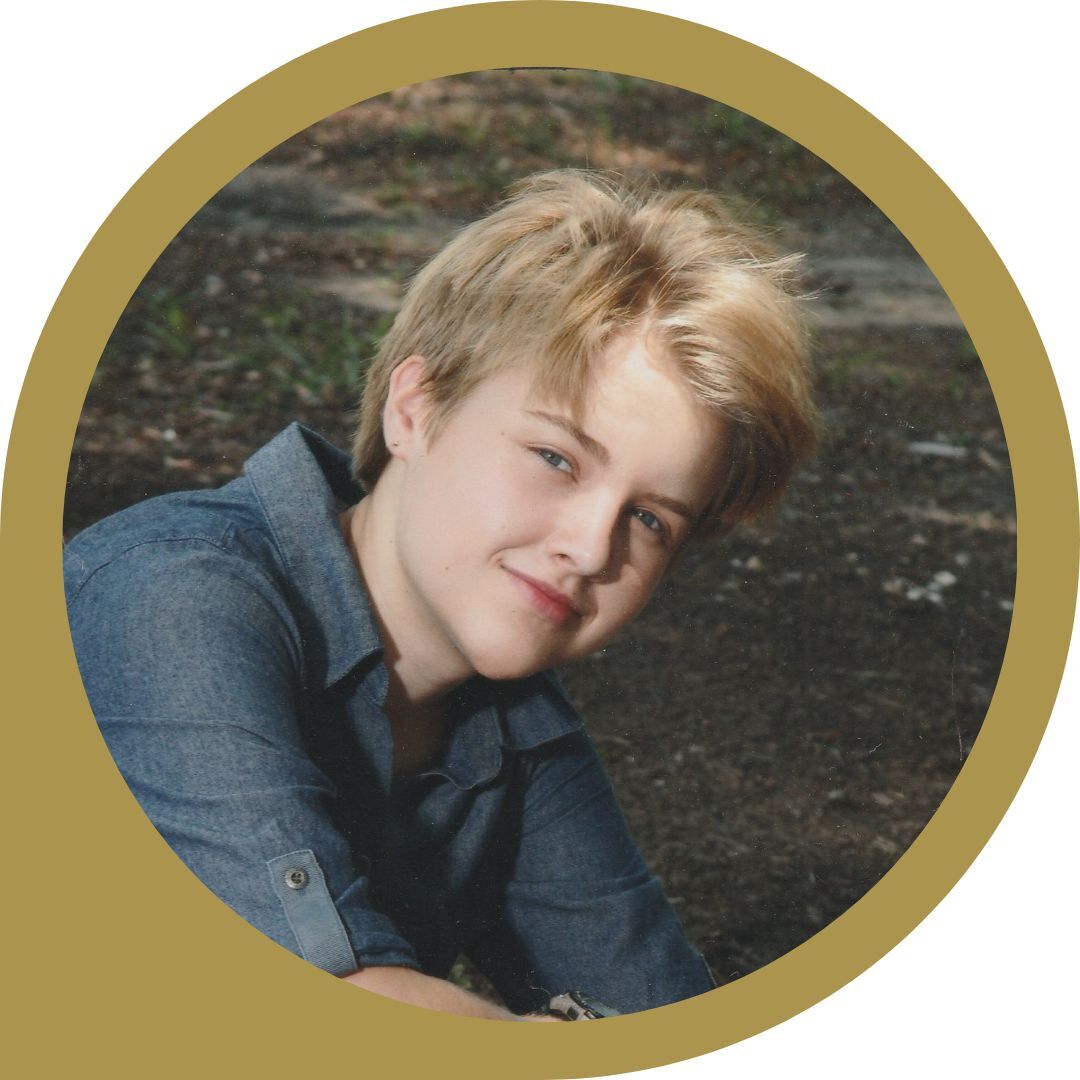
Down By the Riverside by Sara Thompson is shortlisted for the 2023 Author of Tomorrow, 16-21 Category.
Down By the Riverside: After escaping from prison, a young man attempts to hike to safety through dense South American jungle. Far from civilisation, he encounters a young boy, also lost. How did the child wander so far from his settlement, and what settlement did he come from?
---
An Interview with Sara:
WNSF: What is your favourite book?
Sara: As a child, I read as much “outdoor fiction” as I possibly could, and loved the Gary Paulsen book Guts, as well as Roald Dahl’s memoirs of his childhood and time as a bush pilot in Africa, Boy and Going Solo. As an adult, I would say that my tastes have veered more towards classic literature, especially horror, adventure, and war. I like Dracula by Bram Stoker, The Stranger by Albert Camus, and Seven Pillars of Wisdom by T. E. Lawrence, though I’ll admit I haven’t finished it!
WNSF: Who is your favourite author? Or one who has inspired you and why?
Sara: One of my favourite short story authors is the early 20th-century British writer Saki, or H. H. Munro, who wrote these sharp, twisty little short stories with large doses of social satire and commentary within them. I think that the twist endings and unspoken implications that abound in his work have influenced strongly how I plot my own short stories. My favourite story by him is Sredni Vashtar, about a sickly boy who comes to worship a polecat-ferret he keeps in a hutch in his garage.
WNSF: What was your favourite subject at school?
Sara: My favourite subject in school was always history. Right now, I’m going into my senior year of college as a history major. I’m also minoring in folklore.
WNSF: What does ‘adventure writing’ mean to you? Why did you choose to try your hand at an adventure story?
Sara: I would describe adventure writing as writing driven by action, where the characters end up in some different space or situation than where they started. Adventure can be psychological, but I do feel like there needs to be some element of external threat they have to deal with via action.
I chose to write an adventure story because I like to explore the ways that people react to these threats, and the internal changes that people go through attempting to negotiate the changes in their environment.
WNSF: If you could ask an author anything, what would you want to know?
Sara: When I was 14, I read Harper Lee’s Go Set a Watchman in my English class. It had just come out then, and was offered by the teacher as an alternative for students who had already read To Kill a Mockingbird. Aspects of the novel confuse me, both from an artistic standpoint, and from a historical/cultural standpoint. So if I could ask any author anything, regardless of time and space and mortality, I would ask Harper Lee some things about Go Set a Watchman. Did she really want for it to be published as it was? How did that manuscript turn into, or lead into, To Kill a Mockingbird? And it strikes me as strange that Scout would have built up this image of her father in her mind that she doesn’t realise is untrue until she’s in her thirties. Have they not talked about politics or culture at all in the past twenty-five years?
WNSF: Who would you consider one of your heroes and why?
Sara: I think it’s complicated, talking about heroes. I don’t know if putting people on a pedestal like that is necessarily a good idea. But I think maybe I’d call Norman Borlaug a hero of mine. He was an agronomist who developed strains of disease resistant wheat, which helped battle food scarcity in developing regions in Asia and Latin America during the mid-20th century. His innovations may have saved over a billion people from starvation.
WNSF: What is the most adventurous thing you would like to do, or place you would like to visit and why?
Sara: I have a great love of antique aircraft. There’s a little historical airfield in upstate New York called the Old Rhinebeck Aerodrome, and both times I’ve gone up north, I’ve stopped over there. The last time I was there, I got to take a ride in an old, 1930s biplane. It was so exciting, flying all over the Hudson Valley in an open cockpit like that. So I think that for me, a great adventure would be to study, spend time with, and fly in these old aircraft.
WNSF: Where do you find inspiration for your stories?
Sara: My historical studies are a massive influence on my writing. Not just directly, through setting, but also through themes, perspectives, characterisations. I don’t like writing real people in my stories, because as a historian, I feel like I can never do justice to their personalities, never really depict them the way they were. But a lot of my characters are derived from real people and their quirks.
WNSF: If you could time travel, where would you go and why?
Sara: This is hard, because many of the most interesting historical periods to study are also the most dangerous, unpredictable ones! But if I had some guarantee of safety, I’d like to visit 1936. This was the year the Spanish Civil War broke out and there was an attempted coup in Japan, it was really a complicated, fascinatingly terrible moment in time. I’d also be able to meet my own grandparents as teenagers, which would be strange.
WNSF: What three words would you use to describe your story?
Sara: Haunting, mysterious, poignant.