
Chukwuebuka Ibeh's Blessings is shortlisted for the 2023 Wilbur Smith Adventure Writing Prize.
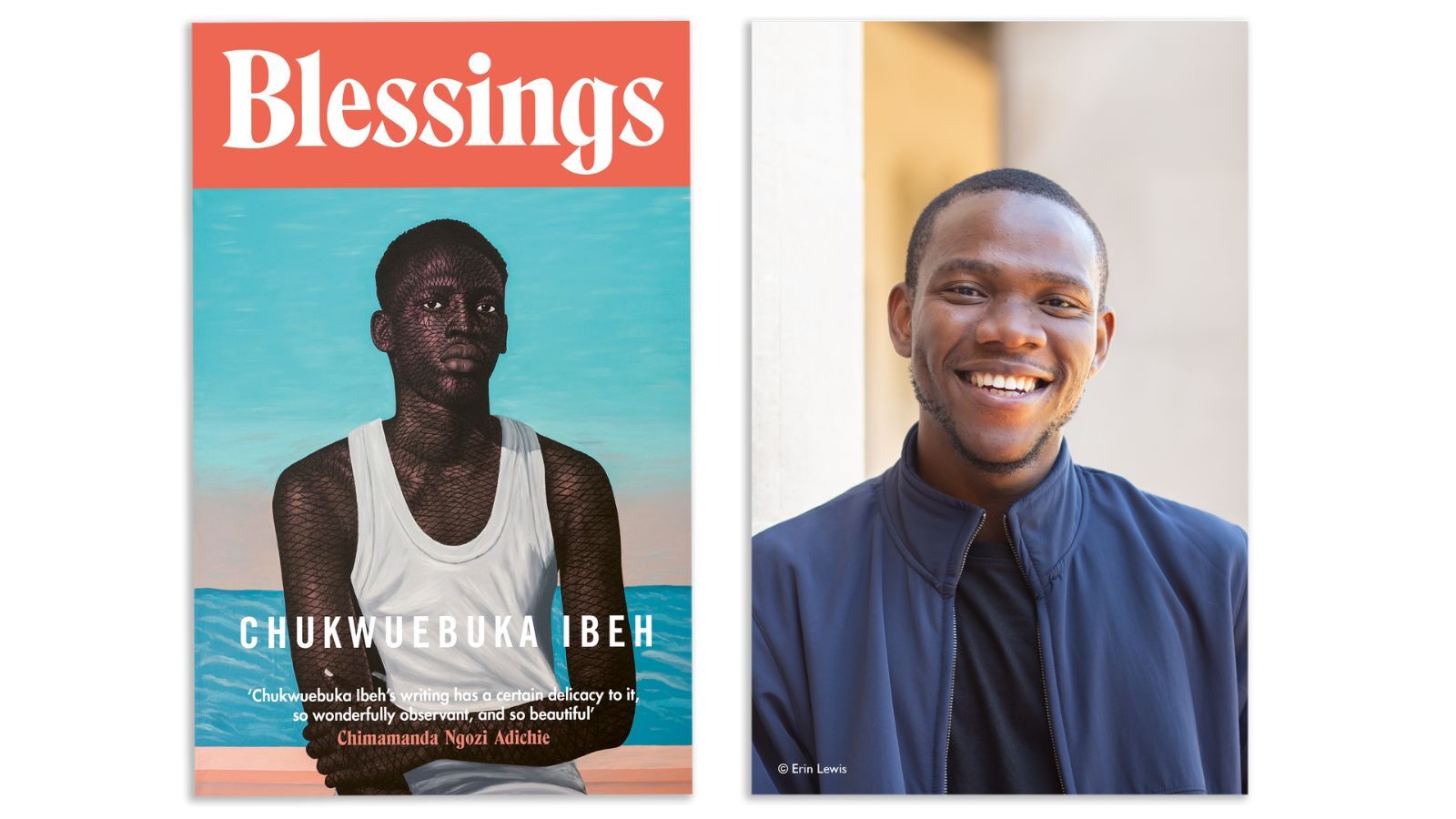
When Obiefuna's father witnesses an intimate moment between his teenage son and the family's apprentice, newly arrived from the nearby village, he banishes Obiefuna to a Christian boarding school. Surrounded by unknown faces that soon become friends, lovers and enemies, Obiefuna finds and hides who he truly is, while his mother Uzoamaka grapples to hold onto her favourite son, her truest friend. When he leaves school as a young man, Nigeria criminalizes same-sex relationships - and Obiefuna's life, or the life he wants to live, becomes even harder to envision - out of reach in a way that is more dangerous and tangible than before.
Told from the alternating perspectives of Obiefuna and his mother Uzoamaka, as they reach towards a future that will hold them both, BLESSINGS is an elegant and exquisitely moving story of love and loneliness. Asking how we can live freely when politics reaches into our hearts and lives, as well as deep into our consciousness, it is a stunning, searing debut.
About the Author: Chukwuebuka Ibeh is a writer from Port Harcourt, Nigeria, born in 2000. His writing has appeared in McSweeneys, The New England Review of Books and Lolwe, amongst others, and he is a staff writer at Brittle Paper. He was the Runner-up for the 2021 J.F Powers Prize for Fiction, a finalist for the Gerald Kraak Award and Morland Foundation Scholarship and was profiled as one of the "Most Promising New Voices of Nigerian Fiction" in Electric Literature. He has studied creative writing under Chimamanda Ngozi Adichie, Dave Eggers and Tash Aw. He is a student on a fully funded MFA programme at Washington University in St. Louis, Missouri, until 2024.
WNSF: Congratulations on being selected for our shortlist! What does adventure writing mean to you? Would you have considered yourself an adventure writer before being shortlisted for the Prize?
Chukwuebuka: When I hear the word ‘adventure’, I think of an experience, often exciting, fun-filled, action-packed; but could also be daunting, teachable, inspiring. I imagine, therefore, that adventure writing would mean any writing that manages to create a narrative that engages the above-listed, whether it’s a thriller about a serial murderer, or a sci-fi about space, or a literary novel about a young man’s coming-of-age in conservative Nigeria. I’ll confess that I was shocked to be longlisted for the prize because I think I had a narrow envisioning of ‘adventure writing’ prior to the longlist and didn’t think literary novels qualified. I’m so glad the prize readers and judges disagree and I’m just so delighted to be on the list!
WNSF: Are there any particular books or authors which have made a lasting impact on you?
Chukwuebuka: I grew up reading a lot of Nigerian classics, so I owe my early interests, I think, to them: Chinua Achebe, Cyprian Ekwensi and Buchi Emecheta are highlights. I admire the works and worlds of Chimamanda Adichie, Raymond Carver and Jhumpa Lahiri. In recent years, I have re-read The Tenderness of Wolves by Stef Penney more times than is probably recommended. It’s a book I hold dear to my heart.
WNSF: Can you tell us about any adventurous experiences in your life? Have they influenced you as a writer or your writing?
Chukwuebuka: Like the main character of my novel, I too attended a boarding school (although under different circumstances). The implication of that is, of course, a sense of independence pretty early on and I was forced, quite literally, to grow up. I often joke that my boarding school did feel sometimes like the set of Hunger Games and that kind of environment makes growing up feel like an adventure. It’s a lesson in survival of the fittest and difficult decisions and compromises often have to be made. These often form the basis for my writerly curiosity, so yes, I would say they have definitely influenced my writing.
WNSF: The Librarians and Library Staff who read, reviewed and selected your book for the shortlist wanted to ask you some questions too. One asked, 'As an adventure story driven by human connections, moments of touch and proximity (both gentle and violent) feel central to Blessings - from Obiefuna’s dancing with Ekene to his hidden touches with Sparrow, or the beating of Festus. As you started writing Blessings before the pandemic, do you think you were influenced by this period of no touch and proximity to place such focus on how moments of physical closeness drive Obiefuna’s adventure?
Chukwuebuka: It definitely is possible, because, like you said, most of the novel was written in isolation due to lockdown resulting from the pandemic. But the truth is that my writing process in itself is unconscious, and so the influence of the pandemic would also have been unconscious, so to speak. It’s hard, therefore, to draw a clear line between both. What I can say, though, from experience, is that most of male socialisation in Nigeria is physical, whether that is through sports as an activity (dancing, in the case of Obiefuna), or even sexual (the touches with Sparrow), or violence (as in the beating of Festus). I honestly do think those plot realities would be in the novel regardless of the time it was written.
WNSF: Another asked, 'Whilst we root for Obiefuna as our protagonist, he is not always the ‘typical’ adventure protagonist - such as when he acts as a passive bystander to Festus’s beating. Was it important to you that Obiefuna represent the complexity of showing courage and bravery in such an oppressive society?
Chukwuebuka: Yes it was. I very much wanted him to be a three-dimensional character instead of being a perpetual victim. I imagine it is human nature to have something of a villainous side and it was very important to me to show Obiefuna’s. We know, of course, that this villainy is stemming from a larger threat beyond his control, but that was the point, I think: for me to show how ultimately vulnerable we can be in the face of these threats, how we could very easily become our worst nightmares when push came to shove.
WNSF: Another asked, 'The setting of the Nigerian boarding school which Obiefuna attends was told with such a rich and vivid depiction, and so well suited to this coming of age tale; would you ever set another, different type of story in this setting, a thriller or romance perhaps?'
Chukwuebuka: Absolutely! I don’t know if it counts, but I do have a couple of short stories also set in Nigerian boarding schools that, I hope, evoke similar emotions, even if their plots are completely different.
WNSF: And finally, they wanted to know, 'Are you working on your next novel? I’d love to hear more about it!'
Chukwuebuka: I am! The plot details are still hazy in my imagination but all I can say right now is that it’s a fictional account of the life and execution of a historical Nigerian figure told from the perspective of his fictional children who are looking back in time to piece together the fragments of their family’s past.
WNSF: That sounds brilliant. We can't wait to read it! Can you tell us about a particular relationship between two characters in your novel and how you made it feel genuine?
Chukwuebuka: My novel is told from the perspective of two characters: a boy named Obiefuna and his mother Uzoamaka. I wanted to paint a portrait of motherly love that is complicated by homophobia arising from religion and morals. It was important to me during the writing process to centre two feelings – love and confusion. Both characters share these feelings and I think I went over too many drafts and re-writes trying to make it as real as I could.
WNSF: What would you consider to be the upsides, and the downsides, of being an author?
Chukwuebuka: Upsides: I get to tell stories I want to read. I get to create this whole new world and fill it in with people that interest me, and even better, I get to introduce them to the world and receive such love. The downsides would always be the occasional rejections. They never get easier.
WNSF: Thank you so much for answering our questions, and congratulations again on being shortlisted!