
Costanza Casati's Babylonia is the winner of the 2025 Adventure Writing Prize.

There are whispers of her fame, in the land long since turned to dust. The Queen who rose from nothing – and changed everything...
Ancient Assyria, 9th century BC. An orphan is raised on the outskirts of a brutal empire. Heir to a tragic prophecy, Semiramis dreams of wielding power and escaping her destiny.
Far away, a reluctant prince walks the corridors of his gilded palace in a city built by the gods. Ninus would rather spend his days in books and poetry than conquering the world of men. But when he meets Onnes, a broken, beautiful warrior, something awakens in them both. And as they grow into young men, their friendship deepens into something fiercer still.
That is until Semiramis arrives. A savage love soon erupts between them all, even as a dark threat to the kingdom mounts. For Ninus and Onnes, one of them will be called to make a devastating sacrifice. For Semiramis, it will become impossible to distinguish between enemy and friend. And before long, all three will be forced to learn the lesson of the gods - in Babylonia, you must bend the world to your will. What doesn't bend, you break.
An Interview with the Author:
WNSF: Congratulations on bein for the Best Published Novel award! What does adventure writing mean to you? Would you have considered yourself an adventure writer before being shortlisted for the Prize?
Costanza: When I think about adventure writers, J. R. R. Tolkien immediately comes to mind – The Hobbit, for me, is the ultimate adventure novel – but also Kipling, Jules Verne and Robert Louis Stevenson. I loved reading those books growing up but, because of them, when I was younger, I used to think that adventure novels were written by men for men. What I am interested in with my writing is to show that women’s lives can be as exciting and adventurous. The stories of women from the ancient world, in particular, are often incredible journeys that explore themes of bravery and endurance. Just like the Odyssey and the Gilgamesh epics follow the quests of men – to journey home from Troy or, in the case of Gilgamesh, to search for immortality – Semiramis’ story, as told in the ancient texts, is equally extraordinary: her rise from abandoned orphan to ruler of Assyria is faced with danger and endless challenges, both physical and emotional. To me, being shortlisted for the Prize is so special because it shows that adventure as a genre belongs to women too.
WNSF: Are there any particular books or authors which have made a lasting impact on you?
Costanza: In Memoriam by Alice Winn and The Art of Joy by Goliarda Sapienza are books that recently had a great impact on me. In Memoriam tells the love story of two schoolboys as they are thrown into the horrors of WWI. It is a book both epic and intimate, one that reflects on the notions of beauty and bravery, while showing us the devastation of the frontline. It haunted me for months after reading it.
The Art of Joy, by Italian author Goliarda Sapienza, was rejected several times when it was written in 1976. Sapienza's husband kept the manuscript for years, publishing a few copies himself before it was taken up by Italian publishers and called ‘a forgotten masterpiece.’ A book of both romance and adventure, it tells the incredible story of Modesta, a woman who makes her way through Sicily’s violent twentieth century, from a brutal childhood to an isolated convent to a princess’ palace. It is a shocking coming-of-age novel about the joys of being alive.
WNSF: Can you tell us about any adventurous experiences in your life? Have they influenced you as a writer or your writing?
Costanza: There have been lots of adventures in my life – swimming with sharks, climbing mountains, living alone abroad without speaking the language – but, for some reason, what came to mind as soon as I read the question was my background as a ballet dancer. I have always associated adventure with endurance, both physical and emotional, a quality that is crucial for ballet. I started ballet when I was three years old and living in Italy (my family is Italian, and I grew up in a village in Northern Italy until I moved to London when I was nineteen.) I remember the long drives through the countryside when my mother took me to classes, the examinations, the dreams of going to La Scala Theatre.
As a child, I thought dancing was a way to tell stories, much like writing or acting. The hours spent in class, learning endless steps while the sun set outside and the music floated out of the windows into the yard; the cold changing rooms where we would cover our feet with plasters before wearing pointe shoes; the anxiety before big recitals, where I waited behind the curtains, listening to the murmurs of girls as they nervously repeated their steps; the competitions, where rooms filled with dancers in bright-colored dresses, moving around gracefully like birds about to take flight.
Growing up, ballet was an adventure and a challenge, but one that taught me a lot about dedication and resourcefulness, as well as the all the hard work and sacrifice that go into creating something beautiful.
WNSF: The Librarians and Library Staff who read, reviewed and selected your book for the shortlist asked the following questions: "Where did Babylonia begin for you? Was there a particular moment or image or historical detail that first sparked Semiramis’s story in your imagination?"
I first discovered the character of Semiramis while reading a book called On Famous Women (‘De Mulieribus Claris’) a collection of women’s biographies by 14th century Italian author Giovanni Boccaccio. Boccaccio tells the stories of some of the greatest women from antiquity – Helen, Clytemnestra, Cleopatra, Lucretia – focusing on their deeds and what makes them legendary. The book is a wonderful exploration of women in power and the way in which they were perceived in the past but, of course, being written in the 14th century, its nature is inevitably moralising, as Boccaccio divides the characters into two categories that exemplify vices and virtues. Semiramis falls into the former.
Boccaccio initially calls her ‘skilled’ and ‘intelligent,’ describes her as a commander of armies and a great ruler. He recounts an anecdote of Semiramis combing her hair while the news of a Babylon rebellion reached her: she threw aside her comb, took up arms and sieged the powerful city. Interestingly, this incident has been depicted countless times by painters throughout the centuries. But then, Boccaccio writes, ‘one wicked sin stained all her accomplishments’: ‘she burned with desire’ and ‘gave herself to many men.’
Boccaccio’s account of Semiramis is inevitably biased: his writing is part of a tradition that sees women in power as flawed and dangerous, but reading On Famous Women was the moment that sparked my imagination and made me research Semiramis’ incredible story: ‘She wanted to show that in order to govern it is not necessary to be a man, but to have courage.’
WNSF: Another asked, "Semiramis is such a vivid and powerful character. What was it like to write her? Were there parts of her mythology or legacy that you wanted to reclaim or reimagine? And did your view of her shift as you spent time with her on the page?"
Costanza: Semiramis has suffered greatly at the hands of history. Throughout the centuries, especially in the Christian tradition, she has become the embodiment of the lustful seductress. She has been associated with Babylon, both as the great ancient city and as a symbol of corruption, lust and dissolute power. Dante, Petrarch, Boccaccio, Rossini and Voltaire have all written about her. In his Inferno, Dante puts her in the circle of lust, next to Helen, Dido and Cleopatra – ‘to sensual vices she was so abandoned,’ the poet writes, ‘that lustful she made licit in her law, to remove the blame to which she had been led.’ Petrarch uses her as an example of ‘evil, unlawful and distorted love’. In his 18th century book The Two Babylons, Christian minister Alexander Hislop called Semiramis ‘the whore of Babylon.’
I wanted to reclaim Semiramis’ reputation by going back to the way in which she was portrayed in the earliest sources (Herodotus, Diodorus of Sicily): as a cunning, resourceful woman who rose to power despite all the challenges in her way. Semiramis is a legendary figure, but she is based on the historical queen Sammu-ramat who, in the 9th century BCE, ruled an empire that stretched from the Mediterranean coast to present day Western-Iran. Her power and influence, as well as her political dominance, were so great that, as soon as she died, her story became the stuff of legends. As I wrote and rewrote her story, my view of her kept shifting: the more I learned about her, the more slippery she became; the more I tried to understand her, the more she seemed to elude me. Until I understood what the real challenge was: Semiramis was an extraordinary woman, one who achieved things that no one else did – how could I make readers empathise with her? How could I make her human, relatable?
The answer came to me halfway through my second draft: one of those moments when the character has lived in your head for long enough and, suddenly, something unlocks. I understood then that the core of Semiramis’ character was ambition, but not in the usual meaning of ‘thirst for power’, but rather the need to be somebody, to not be a nobody. This ambition, this quest for power as a means of survival, is the underlying theme of Babylonia.
WNSF: Finally, one asked: "The relationships in the book (especially between Semiramis, Ninus and Onnes) are so rich and full of tension. Did those dynamics evolve as you wrote, or were they always central to the story?"
Costanza: Before I start working on a new novel, I always look for the main emotional hook – that beating heart that carries the story forward. With Babylonia, I found it in the dynamic between Semiramis, Ninus and Onnes. After coming across Semiramis’ story in Boccaccio’s collection of biographies, I started reading and researching about her and I quickly discovered the writing of Ancient Greek historian Diodorus of Sicily (90-30 BCE). In his Universal History, Diodorus gives us a detailed account of Semiramis’ life and her extraordinary ascent to power. Diodorus tells us that Semiramis was an orphan, abandoned by her mother and adopted by a shepherd. She grew up in a small village at the edges of the empire, until she came of age and caught the attention of a man named Onnes – the governor of the region and the closest friend to the king, Ninus. Onnes married Semiramis and brought her with him to the capital. When, during a campaign to the faraway land of Bactria, Semiramis came up with the winning strategy to make the city surrender, the king fell in love with her. After the battle, a love triangle formed between the characters, one that ended in tragedy: ‘the king, marvelling at the ability of the woman, became infatuated with her and tried to persuade her husband to yield her to him of his own accord. And Onnes, partly out of fear of the king's threats and partly out of his passion for his wife, fell into a kind of frenzy and madness, and killed himself. Such, then, were the circumstances whereby Semiramis attained the position of queen.’
The relationship between Semiramis, Ninus and Onnes was central to the novel from the very beginning: Babylonia is, at its heart, the story of people who, in a world of ambition and ruthlessness, see love as a weakness, and yet cannot help but be swept up in its feeling.
WNSF: Thank you. Your novel is historical fiction - how do you make sure your characters, their voice and actions, sit comfortably within the historical context?
There is a quote that I love from the brilliant Hilary Mantel, where she talks about the relationship between history and the past: ‘history is not the past,’ she believes, ‘but the method of interpreting the past, the record of the record.’ Her concern as a writer, she claimed, was with ‘the memory of the restless dead’: ‘as soon as we die, we enter the world of fiction.’
I am fascinated by the idea of fiction as a way of interpreting history, of art as something we turn to, to see the dead come alive again. In order to achieve this feat, to ‘resurrect the dead,’ as Mantel puts it, research is vital. I love doing a lot of academic research, but I am especially interested in recreating the texture of lived experience. While researching, I usually start with reading a lot of ancient literature from the period, whether it’s love poems or proverbs or ritual poetry – that helps me immerse myself into the mindset of my characters, find their voices and understand their motivations. Studying the ancient texts and using them as references in my novel helps me ensure that my character’s feelings and actions make sense according to the world they inhabit. For Babylonia, reading and studying the epic of Gilgamesh was probably the most essential piece of the puzzle.
Gilgamesh is the first epic ever written, a thousand years older than the Iliad and the Odyssey. Gilgamesh, its titular hero, is based on the historical king who ruled the Mesopotamian city of Uruk around 2750 BCE. The text, famously called ‘the epic of the fear of death’ (Reiner Maria Rilke) is a story about friendship, love in the face of loss, and the quest for immortality. The poem is the original quest narrative, but it is also an anti-quest: after going on endless adventures together, Gilgamesh loses his best friend and lover Enkidu, and never achieves what he has travelled half across the world to obtain.
Gilgamesh deeply shaped my novel, both in terms of its themes and its characters. While Semiramis is based on Gilgamesh himself – relentless in her ambition and pursuit of power and immortality –, the relationship between Onnes and Ninus is inspired by the one between Gilgamesh and Enkidu, a great unforgettable friendship and love story not unlike that between Achilles and Patroclus.
WNSF: Can you tell us about a particular relationship between two characters in your novel and how you made it feel genuine?
Costanza: The relationship between Semiramis and Ribat is one I care deeply about. Initially Ribat wasn’t one of the three perspectives in the novel, but one day his voice came to me so vividly that I decided to include him in the narrative. He and Semiramis both come from nothing and see themselves as so much more than their stations: together they show the influence that even the most unlikely characters can have on history.
Then, there is the bond between Ninus and Onnes, which allowed me to write about queer relationships in the ancient world. There is something heartbreaking about their story: two people grown up together, bound by love, loyalty and obsession, and the struggle that they go through when they are forced apart. To depict their dynamic, as well as the changes they are subjected to after the war, I drew heavily on both literary sources (Gilgamesh) but also the idea that Assyrian soldiers might have suffered from PTSD: researchers recently found a text that describes how an Assyrian king’s mind ‘changed’ after the endless fighting and campaigning.
WNSF: A strong sense of place is vital to any great adventure story. What role does research play in your writing? How did you make your setting feel realistic?
I often think about setting as if it were a character. There is a scene in Babylonia where Ribat is walking through the streets of the Assyrian capital and thinks that ‘Kalhu is always hungry, for slaves, for riches, for blood. It fools and tricks with its magnificence, but underneath it, it stinks and sweats and lashes.’ I imaged a city that was as cruel as the kings who built it and this image came from the way in which Assyrian capitals were described in Israelite writings: ‘Cities of blood, full of lies, full of plunder.’
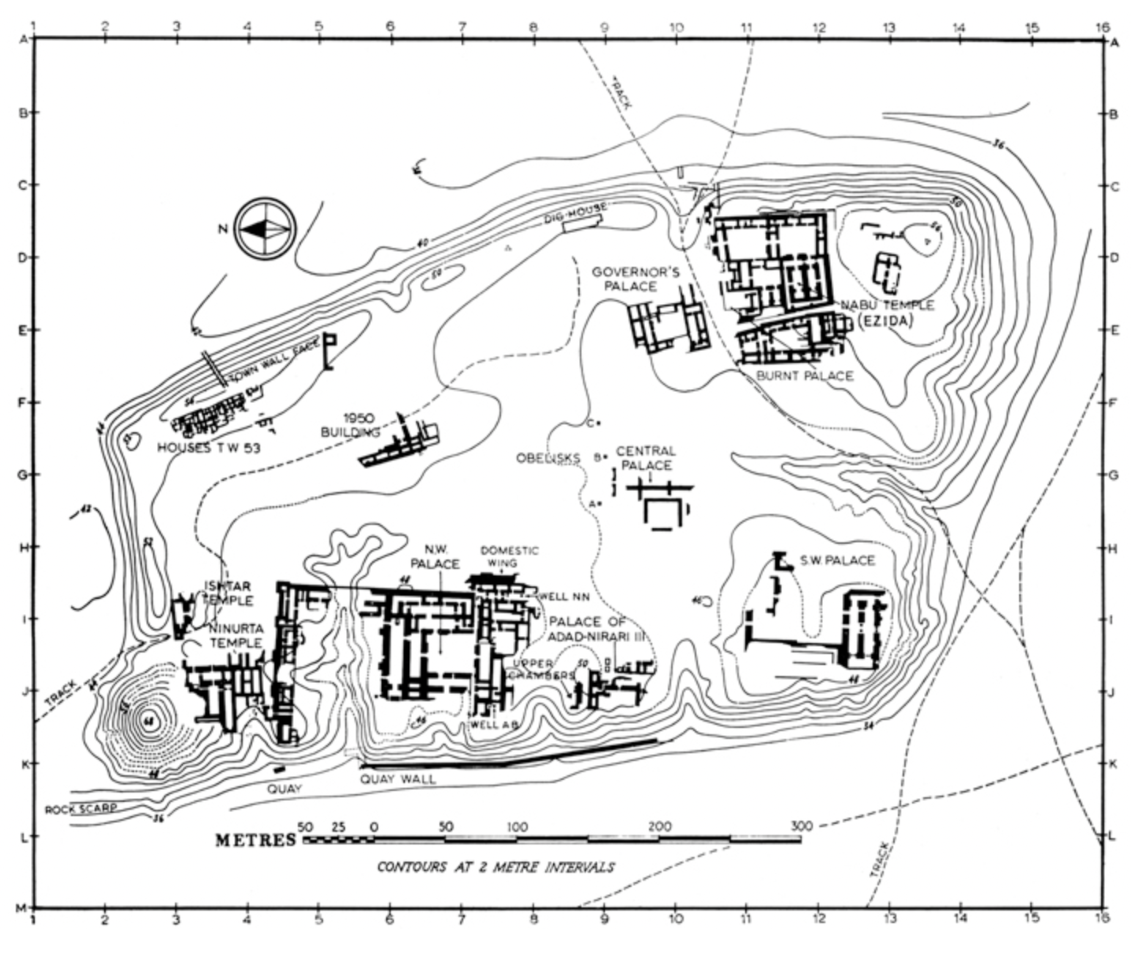
Caption: Citadel plant of the ancient city of Kalhu, capital of the Assyrian Empire.
The most important thing for me, when it came to setting, was to depict this coexistence of beauty and brutality in the world of Ancient Assyria: the bas-reliefs the lined the palace walls were beautifully intricate, and yet they often depicted brutal scenes of warfare; while nobles feasted on the terraces of the hanging gardens, surrounded by lyre players and exotic animals, there were people tortured and impaled on the walls.
To create the sense of place in a novel, there are two types of research that I like to do: one is the immersive research that tries to understand the mindset of the period, the other is the more ‘practical’ research that focuses on specific details of the world and its characters – what kind of wine and beer did people drink in Ancient Mesopotamia? How did Assyrian governance work? What kind of jewelry did noblewomen wear? Did contraception exist? What were the most common food recipes?
I wove a lot of these details into the book. For instance, the description of the bas-relief in the North-West Palace mirrors the actual bas-reliefs that would have been there at the time (the maps in the book also mirror the exact archeological excavations of Kalhu and the Palace). My descriptions of the hanging gardens mirror those found in ancient writings like Herodotus’, while also taking into account more recent research that indicates that the fabled ‘hanging gardens of Babylon’ were actually at the palace gardens of the Assyrian capitals.
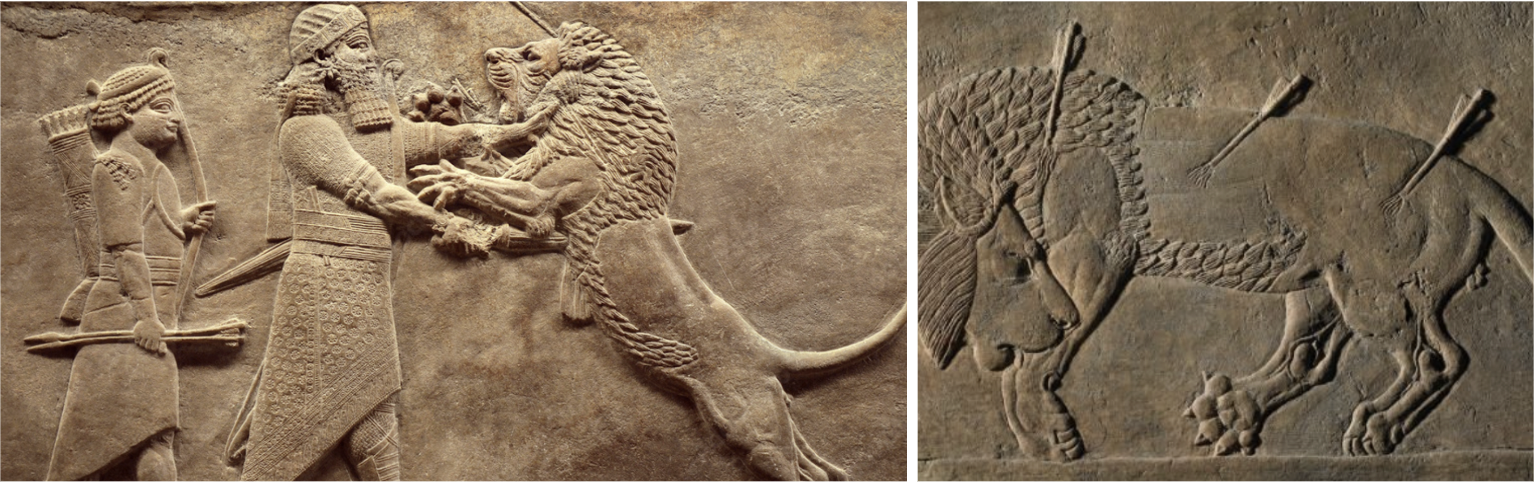
Caption: Bas-reliefs illustrating the Assyrian royal lion hunt.
WNSF: Thank you so much, Costanza!
If you read and loved Babylonia as much as we did, you can vote for it to win the Prize here. If you haven't yet read it, you can purchase your copy here:
About the Author:
Costanza Casati was born in Texas and grew up in a village in Northern Italy, where she studied Ancient Greek, and Ancient Greek literature, under one of the country’s most rigorous academic programmes. She is a graduate of the prestigious Warwick Writing MA in the UK, and has worked as a screenwriter and journalist. Her debut novel, Clytemnestra, has sold into 20 territories worldwide, was the winner of the Goldsboro Books Glass Bell Award and was shortlisted for the Historical Writers Association Debut Crown Award. Babylonia, her second novel, was an instant Sunday Times bestseller.
What Our Reviewers Said:
"It left me breathless, uncharacteristically speechless and just amazed by the sheer scope of Casati’s vision. This book is a masterpiece."
"Babylonia is a sweeping, character-driven odyssey that takes us from the margins of empire to the very seat of power. Semiramis’s journey is marked by danger, political intrigue, ambition, betrayal, and transformation—all classic hallmarks of adventure fiction. But beyond the action and momentum, what makes it truly stand out is how immersive and emotionally rich the journey is. It’s not just a physical voyage, but a visceral exploration of power, survival, and self-determination in a hostile, male-dominated world. This is epic adventure with soul."