
D.V. Bishop's City of Vengeance is shortlisted for the 2021 Best Published Novel award. City of Vengeance is an explosive debut historical thriller set in Renaissance Florence.
It's winter, 1536. A prominent Jewish moneylender is murdered in his home, a death with wide implications in a city powered by immense wealth. Cesare Aldo, a former soldier and now an officer of the Renaissance city’s most feared criminal court, is given four days to solve the murder: catch the killer before the feast of Epiphany – or suffer the consequences.
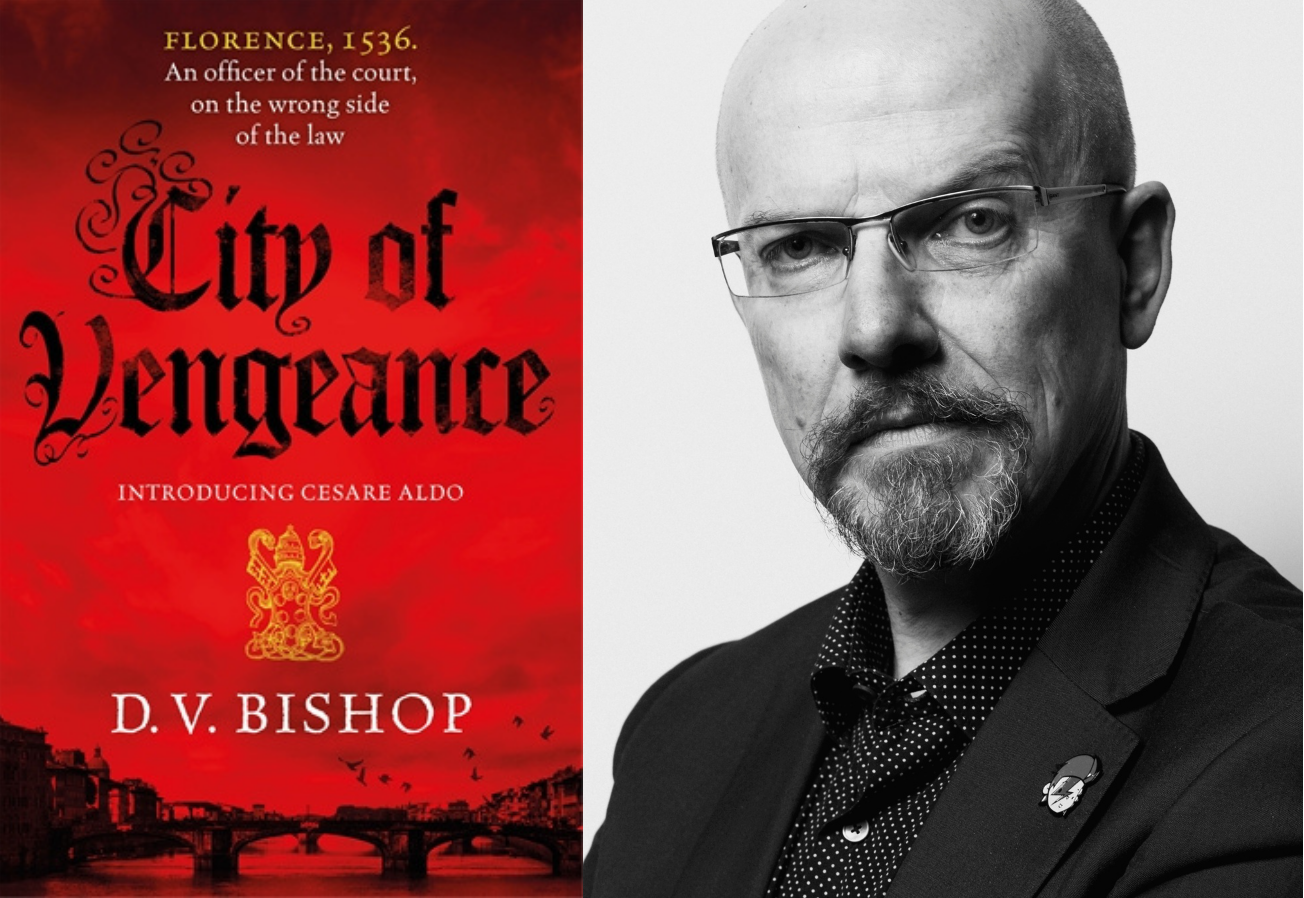
During his investigations Aldo uncovers a plot to overthrow the volatile ruler of Florence, Alessandro de’ Medici. If the Duke falls, it will endanger the whole city. But a rival officer of the court is determined to expose details about Aldo’s private life that could lead to his ruin. Can Aldo stop the conspiracy before anyone else dies, or will his own secrets destroy him first?
About the author:
D. V. Bishop is an award-winning screenwriter and TV dramatist. His love for the city of Florence and the Renaissance period meant there could be only one setting for his crime fiction debut. City of Vengeance won the Pitch Perfect competition at Bloody Scotland 2018, and he was awarded a Robert Louis Stevenson Fellowship by the Scottish Book Trust while writing the novel. When not busy being programme leader for creative writing at Edinburgh Napier University, he plans his next research trip to Florence.
WNSF: What does adventure writing mean to you? Would you have considered yourself an adventure writer before being shortlisted for the Prize?
D.V. Bishop: For me, adventure writing means pushing characters far beyond their everyday experiences, forcing them to take risks beyond anything they have ever known. The character goes on a journey which can be physical, emotional, or spiritual. There is an element of risk and reward in adventure writing, a character facing danger, death or their greatest fear in the hope of attaining what seems impossible. That prize is not always something they can hold; often it is more abstract, an idea or an ideal the character believes is worth saving, is worth preserving – that is worth defending.
WNSF: Are there any particular books or authors which have made a lasting impact on you?
D.V. Bishop: That’s an incredibly hard question to answer! Two non-fiction titles have stayed with me for decades. One is Nothing Venture, Nothing Win, the autobiography of great New Zealand mountaineer Sir Edmund Hillary, who conquered Everest alongside Tenzing Norgay and devoted much of his later life to helping the Sherpa people of Nepal through the Himalayan Trust. The other is A Walk Across America by Peter Jenkins, a memoir written by a disillusioned young man in the early 1970s who chose to traverse the USA on foot. It’s a fascinating story, and one of the first books to merge adventure, travel and non-fiction narrative.
WNSF: Can you tell us about any adventurous experiences in your life? Have they influenced you as a writer or your writing?
D.V. Bishop: I was a young daily newspaper reporter in my native New Zealand, writing most of my stories without ever leaving a desk. But I was offered the chance to write a feature about a new venture called ARK – At Risk Kids. It gave teenagers from foster homes and deprived backgrounds, some of whom had been in trouble, the opportunity to have experiences beyond anything they had ever known.
For the first trip, I went along with the youths sailing on a tall ship for five days. You jumped overboard every morning and swam round the ship as your bath for the day. You had to climb the mast and along the yardarm – up to sixty feet above the deck - to gather or lower the sails. I wrote my feature about it, but after that I volunteered to help supervise for a year.
We did all sort of things – abseiling down cliffs, parasailing from a Jeep, white water rafting, marching around volcanos. For one weekend we were left with basic supplies on an uninhabited island to fend for ourselves. We had to build our own shelters, start our own fires, the works. You soon discover the limitations you create for yourself don’t have to be real – especially sixty feet up from the deck of a ship.
WNSF: City of Vengeance is historical fiction, how do you make sure your characters, their voice and actions, sit comfortably within the historical context?
D.V. Bishop: City of Vengeance is set in Renaissance Florence, across twelve days in the Winter of 1536. I was confident that characters living 485 years ago were not that different to people alive today. We still sleep, laugh and love much as the Florentines did all those years ago. Making the historical context credible required so much research. What did people in the different strata of society at that time eat? How did they dress in winter? What was the weather like? What did inside their homes look like?
Capturing the words of 16th Century Florentines was the other challenge. How do you put words in the mouths of people almost 500 years in the past that can still sound credible to a modern reader? Happily, I discovered a missive written by Maria Salviati, a real woman of the period and a key character in the novel. In 1531 she was a widow, and wrote a letter protesting plans to marry her to one Signor Leonello, a man some thirty years older than Maria. She described Leonello as a man ‘whose body is unpleasantly formed, whose breath seriously stinks, and who has the worst constitution imaginable.’ That irreverent mention of stinking breath changed Maria Salviati from a vague outline to someone I could see and hear, a woman of strong opinions and considerable guile in getting her own way. She had a voice, and that gave me confidence to create voices befitting of the characters.
WNSF: A strong sense of place is vital to any great adventure story. What role does research play in your writing? How did you make your setting feel realistic?
D.V. Bishop: I gathered dozens and dozens of books to research Renaissance Florence, spent years reading and learning about the period and its people. But secondary sources only get you so far. For the rest I went to Florence itself (in the days before Covid-19) to get those sensory details of what life must have been life. I walked the narrow alleyways and crossed the grand piazze, tracing the routes my characters would take to criss-cross the city. Happily, central Florence remains much as it was 485 years ago. Ponte Vecchio still spans the Arno, though now the stalls along it span sell tourist items – 485 years ago they were mostly butcher shops! Some street names have changed in Florence, buildings have gone and come, but if you walk through the city before dawn you can imagine yourself back to 1536.
That’s what I did one early morning, following in the footsteps of my main character Cesare Aldo as the law enforcer strode from a bordello south of the Arno, crossing the river via Ponte Vecchio and marching onwards toward his place of work. I had believed I could navigate my way easily without a map or smartphone, but soon got confused. The Duomo is among Florence’s most famous and visible landmarks, yet at ground level it often stays unseen due to the three-storey buildings that line the narrow streets. That experience ended up in the book, though it is a visitor to Florence who gets lost as a result, not a native son of the city like Aldo.