
Derek B. Miller's The Curse of Pietro Houdini is shortlisted for the 2024 Wilbur Smith Adventure Writing Prize.
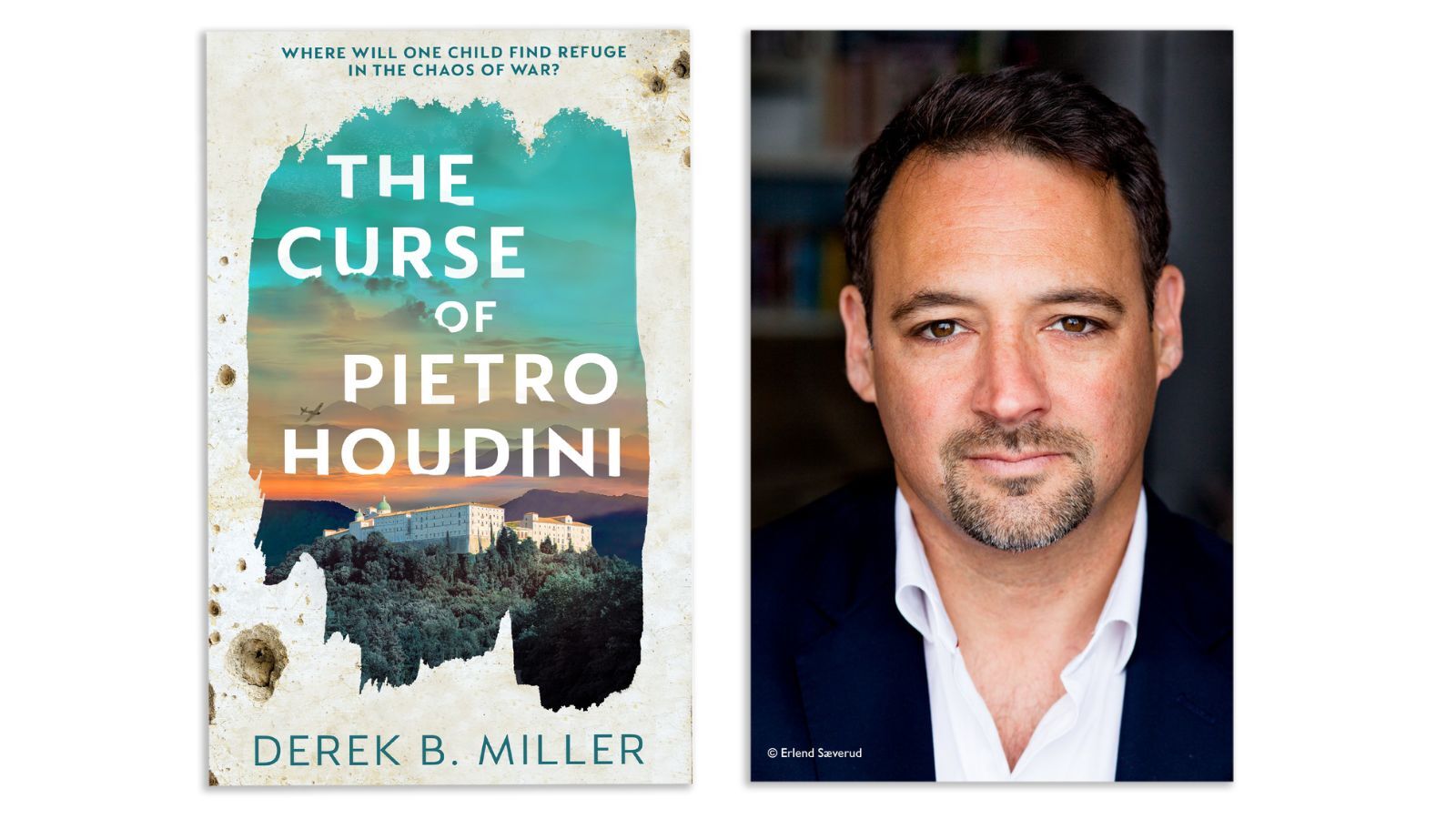
The bombing of Rome in 1943 leaves fourteen-year-old Massimo orphaned and with no choice but to set out on a perilous journey to find his remaining family in Naples. A chance meeting with the mysterious and charismatic Pietro Houdini will deliver both of them to the doors of the monastery of Monte Cassino, a centuries-old haven of contemplation, learning and art.
But the abbey is in the path of the relentless Allied advance to Rome. Pietro and Massimo need a plan to survive the coming onslaught and that means out-manoeuvring the Germans who are as interested in the abbey's art collection as in the murder of two of their officers in the town below. For their plan to work, they must dissemble, disguise, and outwit two armies using skills that Pietro has in spades, but as war edges ever closer, it becomes clear that Massimo is not without a surprise or two either...
The Curse of Pietro Houdini is a sweeping tale of resilience, hope and survival which is at once an action-packed adventure heist, an imaginative chronicle of forgotten history and a philosophical coming-of-age story.
About the Author:
Derek B. Miller is an American novelist, who worked in international affairs before turning to writing full-time. He is the author of six previous novels, all highly acclaimed: Norwegian by Night, The Girl in Green, American by Day, Radio Life, Quiet Time (an Audible Original) and How to Find Your Way in the Dark. His work has been shortlisted for many awards, with Norwegian by Night winning the CWA John Creasey Dagger award for best first crime novel, an eDunnit Award and the Goldsboro Last Laugh Award. How to Find Your Way in the Dark was a finalist for the National Jewish Book Award and a New York Times Best Mystery of 2021.
Miller is a graduate of Sarah Lawrence College (BA), Georgetown (MA) and he earned his Ph.D. in international relations from The Graduate Institute in Geneva. He is currently connected to numerous peace and security research and policy centres in North America, Europe and Africa, and previously worked at the United Nations for over a decade. He has lived abroad for over 25 years in Israel, the United Kingdom, Hungary, Switzerland, Norway and Spain.
WNSF: Congratulations on being shortlisted! What does adventure writing mean to you? Would you have considered yourself an adventure writer before being shortlisted for the Prize?
Derek: I had an interesting experience recently writing a proper mystery, by which I mean someone is dead and the people now are looking backwards to solve it. It turned out well in the end, but I found that I didn’t enjoy writing it nearly as much as I adored writing Pietro. Looking back over my other books (Pietro is my seventh), I realised that the ones I had the most fun writing were those in which I had no idea what was going to happen next while I was writing.
In those novels, the reader and I were on the front lines of the adventure together. If a bear is charging through a supermarket after a tax attorney who was covered in honey by his wife after he was found cheating on her, neither the reader nor I have any idea what’s going to happen when he tries to make the sharp turn in his leather shoes into aisle five. I love everything about that. The camaraderie with the reader, the opportunity for imagination, the chance for comedy and tragedy at every moment. I’m in control of my instrument and at my best. Before this lovely shortlisting (is that a word?) happened, I had already learned this about myself. So I was already using terms like thriller writer, suspense, action, and such. While I didn’t talk about myself as an adventure writer, I would have gladly accepted the description. I’m therefore delighted to be recognized as such. Thank you.
WNSF: Are there any particular books or authors which have made a lasting impact on you?
Derek: Of course. In no particular order, Mark Helprin’s A Soldier of the Great War; any number of books by Mark Twain, James Salter, Michael Chabon, Richard Ford, Richard Russo, John Steinbeck’s The Moon is Down. John Irving. Oscar Wilde, Shakespeare. Cervantes most of all; he’s my touchstone. I’m delighted to be shortlisted with Louis de Bernières, whose Captain Corelli's Mandolin was one of those expansive novels I read in my 20s. Scholastically, I think Adda B. Bozeman had the most influence on my view of international affairs and history. I also read the Greeks, a lot of plays, and as for my tastes these days — not that you asked — I tend to feel the pressure of time and so my tastes orient towards the classics; before it’s too late, and all that. I trade experiencing the progress of our societies for better encountering their origins. I can’t seem to help myself, though I know I’m missing out on both the present and the future.
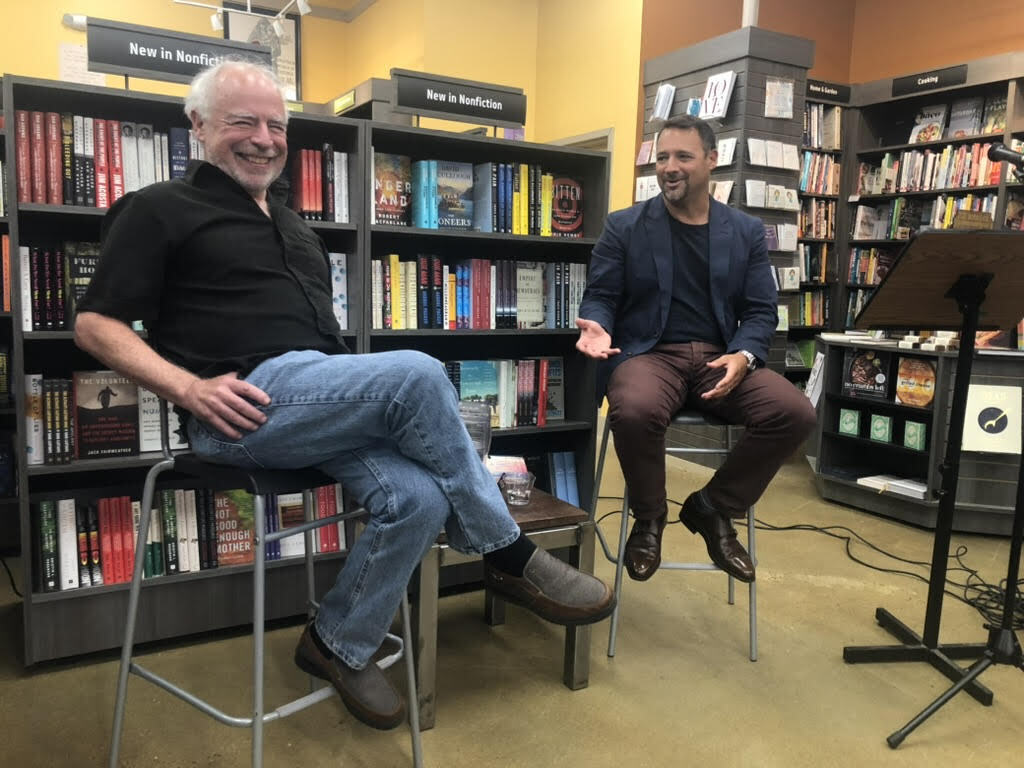
DM: Yucking it up with Richard Russo, Pulitzer winner of Empire Falls.
WNSF: Can you tell us about any adventurous experiences in your life? Have they influenced you as a writer or your writing?
Derek: My life has been eventful. I have lived abroad for over twenty-five years in Israel, Hungary, the UK, Switzerland, Norway and Spain.
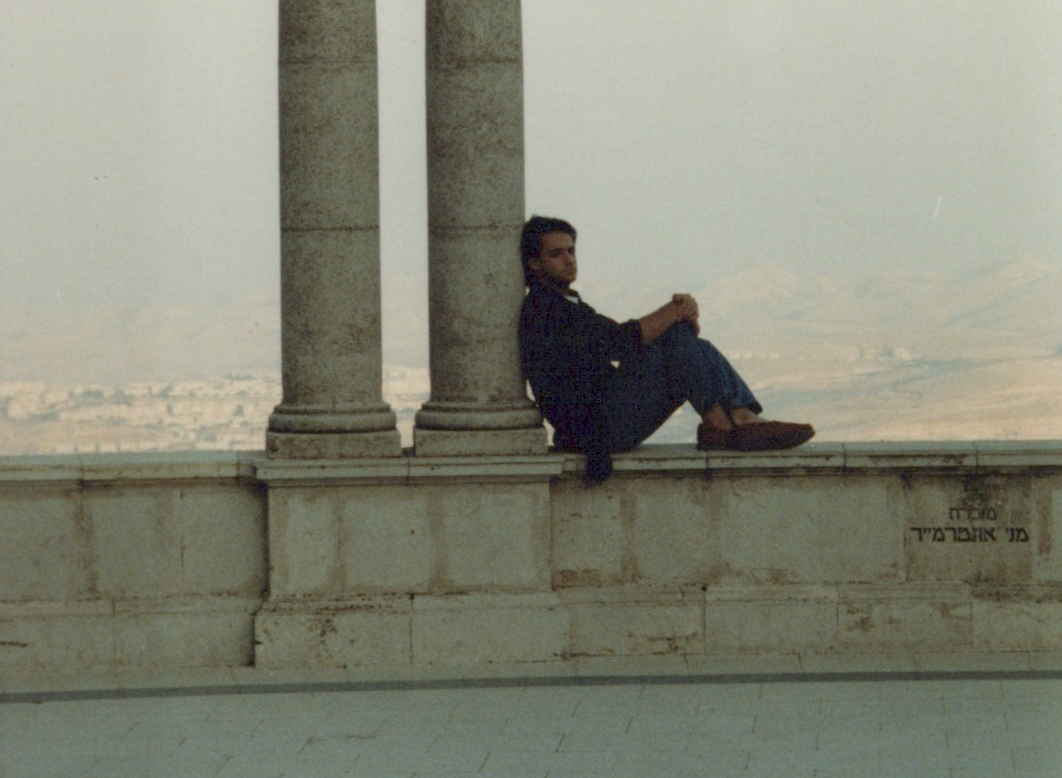
DM: Behind the Hebrew University of Jerusalem, 1991.
I studied at seven universities, earned two MAs and a Ph.D, worked in academia, at think tanks, diplomatic missions, NGOs, the UN for a decade, and launched my own policy design institute. I stopped counting the countries I’ve visited once I got to fifty and, at this point, I’ve been more places than Johnny Cash and I’ve seen more weird stuff than Han Solo. I have two kids, an ex-wife after some twenty-two years together, and I’m still out there swinging the bat every day just trying to find a way to keep all this craziness afloat (does crazy float? It must … right?).
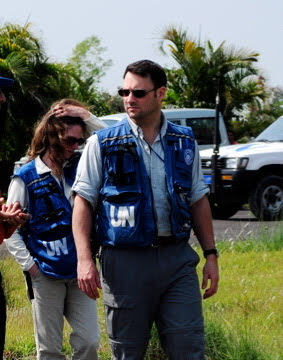
DM: Working for the UN.
My expertise is in international relations and security affairs, and my intellectual commitment was towards comparative cultural research and its use in designing policies and programmes for peace and security.
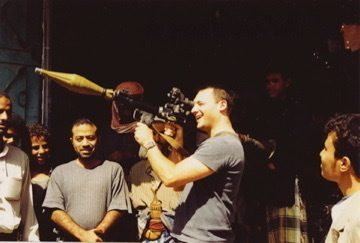
DM: A little shooting with the Yemenis, 2001.
I’ve gone shooting with Yemeni tribesmen; conducted research in Dalit villages in Nepal; hunkered down in sealed rooms under missile attack while in Israel waiting for nerve gas; and I’ve ridden motorcycles across the most exciting and demanding passes in Western Europe over the last twenty years. And after all is said and done, what I like most is being a novelist (well … a father, but novelist is definitely second). Writing is now my greatest adventure because it the most boundless and unexpected and requires the most of me at all times. Sometimes I think I venture-forth only to feed the experience.
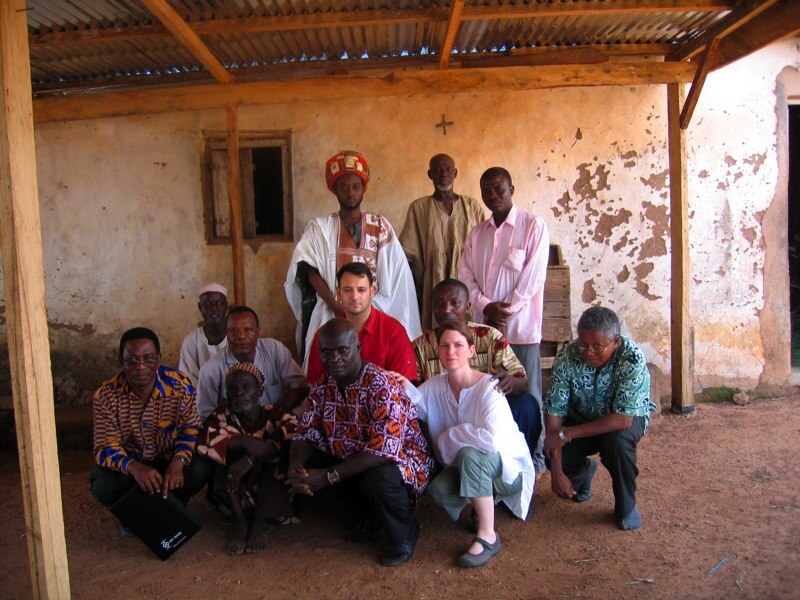
DM: Conflict resolution projects, northern Ghana.
WNSF: The Librarians and Library Staff who read, reviewed and selected your book for the shortlist asked some questions too. One asked, 'The characters in The Curse of Pietro Houdini are intricately woven into the fabric of wartime Italy, each with their own secrets and motivations. How did you go about crafting such a diverse cast of characters, and were there any particular historical figures or events that inspired their development?'
Derek: I appreciate the compliment and observation. I’ve often joked that if I ever write an autobiography it’ll be called Thanks for Noticing.
I don’t craft characters. I think it was Michelangelo who said that he didn’t form the sculptures from the marble, he just chipped away the extra pieces. That’s a conceit and not one I claim to share, but there’s a metaphor in it worth recognizing. As the story develops, I am the first reader. As I imagine a space, a scene, a smell, the way the light illuminates the columns, the way the lemon juice smells against the gold of a mosaic in a crypt beneath the abbey, I look at the shape of the man working. I look at his face, and hear his breathing. I trust my instincts in the moment. Will he make an observation? A joke? Comment on the heat of the lamp, or will he exhale and watch his breath form condensation — for just a moment — on the surface he has just cleaned? What will he think about? Will he consider that only moments ago he told the monks that their breath was killing the paint? Will that make him feel guilty or will he give a mischievous smile that only he and the devil can see? Whichever way the character goes, I allow it. As words and deeds begin to accumulate I get a sense of who the man is. I ask myself whether I like this and if it serves the story. Sometimes I accept that it doesn’t and I have a choice; I can change the character to suit the story or else the story to the character. I usually find the characters are stronger than the story. The story emerges, in other words, from the force of their characters facing the circumstances I have placed them in. I enter a story with some clarity about these circumstances but I learn from them how the story will evolve.
As it progresses I sense the wider environment and mood. Is it time for these people to go outside? To get some air? To see the stars? Is anyone else outside? Perhaps it's time for the conversations to change and we need some new blood. If so, enter a new person. What person?
I think of writing as sailing. I know the port of departure and I usually know where I want to arrive, but between here and there is life. The winds and sea and waves and other people on the ship will all have a say in how the journey unfolds. Perhaps I will find a trailing wind and the story will fly towards its ending as though pulled there. Or perhaps — like Odysseus and Don Quixote — the trip will be long and unexpected and meandering and full of surprises and revelations. In those cases, new people and monsters and gods will be found and the mood of the moment will tell me who they are.
That’s adventure writing! Isn’t it great?
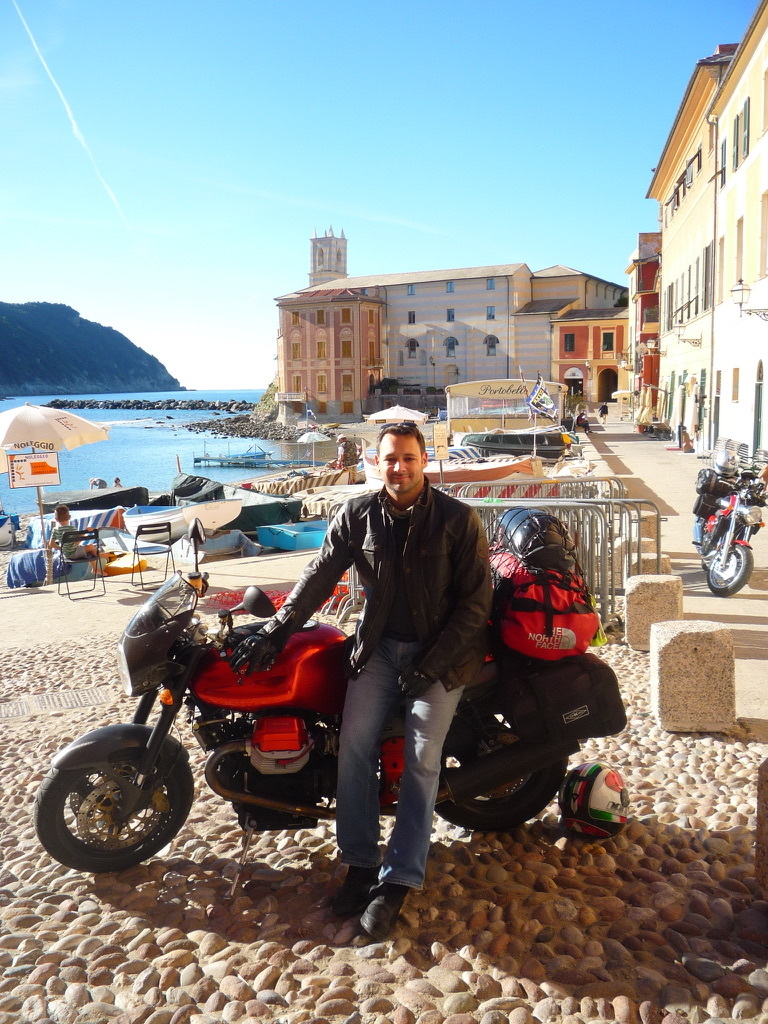
DM: Sestri Levante, Italy, on a Moto Guzzi V11 Rosso Mandello.
WNSF: Another asked, 'The novel seamlessly blends elements of adventure, heist, and coming-of-age tale against the backdrop of World War II Italy. What challenges did you face in balancing these different genres, and how did you ensure that they complemented each other to enhance the overall narrative experience?'
Derek: I have two approaches to thinking about genre. The first is when the genre is recognized as being a distinct as a set of practices that separate both its creation and encounter from other forms. Put more simply, the writer uses a structure to create, and the reader can expect to encounter that familiar structure when read. As Gertrude Stein might have phrased it, there’s actually a “there there.”
The second is when a genre (or term) is imposed (or imputed) on a loosely connected set of forms that share some similarity so they can be discussed together. The writer might be oblivious to having done this, but after the fact she’ll find she’s been grouped together with others who did it too.
These are very, very different uses of the term “genre.”
An example of the first is the blues (in music). The blues are widely appreciated to be structured about a three chord, twelve bar composition with a I chord, a IV chord, and a V chord serving respectively as the tonic, the subdominant, and the dominant. Bars 1-4 are the I chord, 5-6 are the IV chord … and onward. That structure creates a framework for creating unique compositions ranging in mood, style, and passion from Robert Johnson to Bonnie Raitt to BB King to John Mayer. In this sense, the blues is a a genre that provides guidance to the practitioner and expectation in the listener.
And example of the second category — where we impute coherence — is “literary fiction.” In this case, the writers we cluster together under that category did not build their works on a shared and recognized structure (and we’ll ignore the too-clever… “but dude, that IS the structure!” argument). Instead, the authors did their own thing and after the fact they were grouped together and classified by someone who wasn’t oriented towards the act of the writing (i.e., “do this to get that” as we see with the blues) but rather towards the act of reading, (i.e. look in aisle five to find literary fiction, but watch out for the guy covered in honey.).
I don’t want to sound disparaging towards that second use of the term “genre.” It is incredibly helpful to readers — indispensable, really — to be directed towards what they want to find. It’s good for everyone because it brings books and readers together. It is perfectly logical too for a reader to ask a bookseller, “Hey, where’s the literary fiction?” and for Waterstones to say, “18th floor in the corner under the stacks of toilet paper.”
But a writer looking for guidance on how to produce “literary fiction” will be at a loss. “Um … be real serious about stuff?” might be the answer, but then the young writer will say, “but Kurt Vonnegut wasn’t. Nor was Mark Twain. And I’m not sure Oscar Wilde always was either. Dorothy Parker certainly wasn’t. And would anyone really say Cervantes was being really serious about stuff in Don Quixote, which remains the greatest novel ever written?” I wouldn’t. And then everyone gets introspective.
In my case, I ignore genre because I’m not adopting and utilizing a structure to support the story other than the Western three-act model of “setup, confrontation, resolution” (which contrasts to the Chinese model of “Introduction, development, turn, and conclusion,” which I don’t use. But that’s a longer discussion). In short, I think life is all of a piece and is lived forward in motion but also backwards in memory and consideration. So in a sense — as I write — I have to reject any premise which pre-supposes the existence of separate genres that have to be managed. If life itself didn’t separate them into categories I’m not beholden to reconciling anything and if there isn’t a structure I can use to build my story, I can ignore genre entirely. Selling it (i.e. communicating to my readers where to find the book) is a job for my publisher and the booksellers (and God bless them for doing it).
My goal is to keep the ball moving down the field and keeping the drama bouncing along. What people choose to call it on the back end isn’t my concern. Though, to be honest, I wish I made it easier for them sometimes. They are my friends and allies!
WNSF: Finally, more than one asked, 'Are there any upcoming projects on your horizon? If so, we'd love to hear about them!'
Derek: Two. The first is an alternative history spy thriller called Little Satan: A Dangerous Novel, that is set in an alternative 1979 during the Iranian revolution, and it takes as its premise that the Jews and Arabs both accepted the UN’s partition plan of 1948 so by “now” there’s an Israel and an Arab Republic of Palestine living side by side in peace. Until all hell breaks loose.
The second is a sort of Hitchcockean noir set on the Fascist Spanish coast in Cadaques in 1957 where a girl investigates the death of her twin sister five years earlier when the local, and very untrustworthy, chief of police tells her that she too had been pushed off the cliff and it wasn’t the wind that did it. That’s called Tramuntana.
Let’s see what happens.
WNSF: Your novel could be classed as historical fiction. Why did you choose to write about this time? Or that particular place in this time?
Derek: Before Pietro Houdini I wrote a novel called Radio Life. It is a science fiction story about a civilization on the rise long after the apocalypse. That novel is in direct and deliberate conversation with the 1959 science fiction classic called A Canticle for Leibowitz written by Walter Miller, Jr. (no relation). Miller’s vision was that humanity would destroy itself over and over again. I had another one.
I found a review of it in a tiny publication called the Wisconsin Jewish Chronicle. They wrote: ‘The conjunction of day-to-day life with the sweep of centuries, of individual characters and masses of men – all viewed under the aspect of eternity – makes A Canticle for Leibowitz a unique experience in faith and adventure, in raw humanity and in the exploration of the spirit.’
The review continues with a brief biography of Miller, noting that he ‘enlisted in the Army Air Corps a month after Pearl Harbor and spent most of World War II as a radio operator and gunner. He participated in 55 combat sorties, among these was the Benedictine abbey at Monte Cassino, the oldest monastery in the Western World.’
Those who know the book and its author also know that it was Miller’s participation in this raid that led him, in part, to write Canticle. As the Jewish Chronicle put it, it’s ‘the story of another abbey with a somewhat parallel history.’
The part left unsaid in the review was that the abbey at Montecassino, Italy, was erected in AD 529 outside of Rome. The Allies bombed it thinking the Germans had occupied it. After destroying it, the Germans did occupy it. The Battle of Montecassino was comprised of four assaults between January and May of 1944. Some 55,000 allied casualties resulted, and 22,000 German.
The monks of the abbey had copied and accumulated forty thousand manuscripts, including the majority of the writings of Tacitus, Cicero, Horace, Virgil, and Ovid. All were destroyed. The abbey had been filled with hundreds of civilians who had fled there as a sanctuary.
Miller was one of the people who killed them.
According to his agent, Miller was deeply depressed by PTSD and had been for fifty years. His own end was a hard one. According to reports (mostly buried by the family), Miller called the police in Daytona Beach on January 9, 1996 at 8:29 a.m. and said there was a dead man on his front lawn. They arrived three minutes later at 8:32. ‘They found the 72-year old writer sitting in a chair on his lawn, dead from a bullet to the brain.’
A Canticle for Leibowitz won the Hugo Award in ’61 and sold over two million copies. It is a truly great book.
After writing Radio Life I knew I wasn’t done with the abbey. My decision to delve into its history was because the ghosts Miller’s tragedy still haunted me and I suspected – in my heart — that there was still a story there to tell. When I met Pietro Houdini I understood how it would be told.
WNSF: A strong sense of place is vital to any great adventure story. What role does research play in your writing? How did you make your setting feel realistic?
Derek: I am convinced that most people get most of their history from fiction; whether in book-form or on a screen. I find this both worrying and inevitable, so the decision I have as someone who produces the stuff is whether and how to be factual, sincere, and trustworthy as a conveyer of knowledge.
I decided long ago that my approach to historical fiction was going to be as disciplined as that of an historian. When you come to my novels, and learn from them, you are in responsible hands.
In this sense, research (or homework, really) is vital. I begin by reading widely about the time and place and simply dwelling in the emotions and chronology of events. Once I have developed a strong instinct for how people thought and argued and spoke and made decisions, I feel I’m confident enough to begin writing. At that point, my agenda is determined by what I need to know to advance the story, and then I end up learning more through that foray into the material again, and it becomes a virtuous cycle. By the time I’m done with the first draft I’m also the most complete in my knowledge of the period, so I go back to the beginning and start writing it all again from that position. Each book is like a masters degree in a time and place with a three to four hundred page thesis to turn in at the end. But if it reads like that, I’ve failed. It only works when all of that disappears and the drama rises to the top and the fun begins.
As for the setting feeling realistic: it is realistic because it’s real! All I can do as a writer is succeed or fail in turning that wide reality into words which then become images and stories in the mind of others. How I do that, I can explain. How it works is a mystery.
WNSF: Thank you so much for answering our questions, and congratulations again on being shortlisted!
Derek: This is an honor and a pleasure and I really appreciate all of you taking the time to have found this book and given it a brief moment to shine in a world that increasingly feels like it needs to fight off the darkness.
Good luck with the rest of the adventure. Wind at your back.