
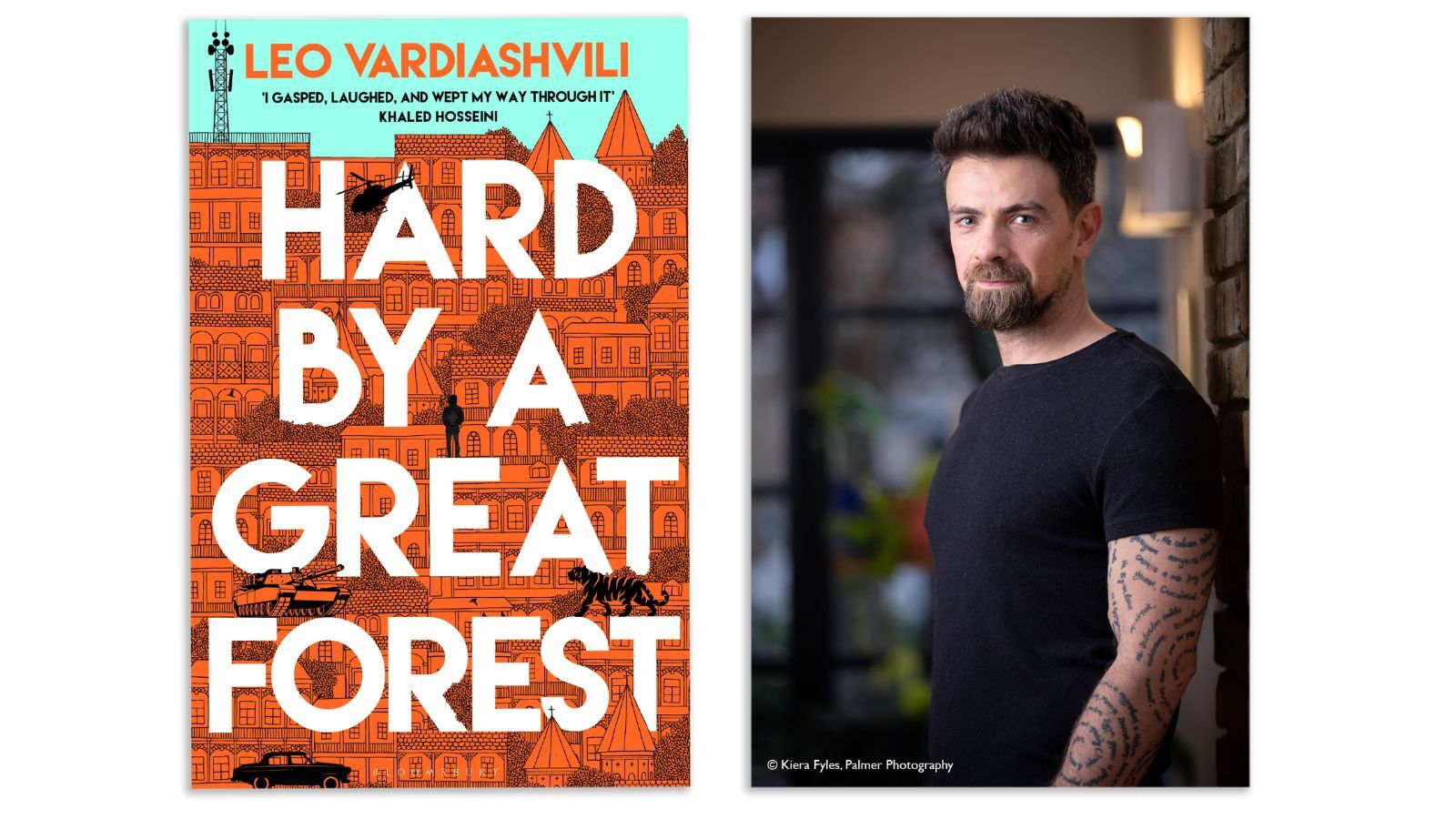
Leo Vardiashvili's Hard by a Great Forest is shortlisted for the 2024 Wilbur Smith Adventure Writing Prize.
Tbilisi’s littered with memories that await me like landmines. The dearly departed voices I silenced long ago have come back without my permission. The situation calls for someone with a plan. I didn’t even bring toothpaste.
Saba’s father is missing, and the trail leads back to Tbilisi, Georgia.
It’s been two decades since Irakli fled his war-torn homeland with two young sons, now grown men. Two decades since he saw their mother, who stayed so they could escape. At long last, Tbilisi has lured him home. But when Irakli’s phone calls stop, a mystery begins...
Arriving in the city as escaped zoo animals prowl the streets, Saba picks up the trail of clues: strange graffiti, bewildering messages transmitted through the radio, pages from his father’s unpublished manuscript scattered like breadcrumbs. As the voices of those left behind pull at the edges of his world, Saba will discover that all roads lead back to the past, and to secrets swallowed up by the great forests of Georgia.
In a winding pursuit through the magic and mystery of returning to a lost homeland, Hard by a Great Forest is a rare, searching tale of home, memory and sacrifice – of one family’s mission to rescue one another, and put the past to rest.
About the Author: Leo Vardiashvili came to London with his family as a refugee from Georgia when he was twelve years old. He studied English Literature at Queen Mary University of London. Hard by a Great Forest is his first novel.
WNSF: Congratulations on being shortlist for the Best Published Novel award. What does adventure writing mean to you? Would you have considered yourself an adventure writer before being shortlisted for the Prize?
Leo: I think all my favourite adventure books have something in common – they nudge you out of your comfort zone and into unfamiliar surroundings – whether that’s the setting, time period, topic and plot, or even the themes. Stepping into the unknown comes with an element of fear. But taking that step never fails to give me a new perspective, new knowledge, and it enriches my own life and writing too.
In the really good adventure books, the ultimate goal (whatever it may be) is never the real point. It’s the journey – the places, characters and events along the way – they’re the real point.
I wasn’t aware I was writing something that would be considered as adventure writing. The thought hadn’t crossed my mind. But Hard by a Great Forest does take the reader into unfamiliar territory, namely Georgia. There is danger in the novel, obstacles to overcome and many comfort zones are abandoned wholesale. I tried my best to describe Tbilisi and Georgia at large in as much granular detail as possible. I also wanted to convey to the reader what the Georgian people are like. In doing this, I was hoping to introduce the reader to a place they might not be familiar with.
Prompted by the shortlisting, for which I am hugely grateful, I’ve realised Hard by a Great Forest can in fact sit quite comfortably under the adventure writing umbrella. I can’t tell you how happy I am that I can take new readers to Georgia and then promptly abscond, leaving them to navigate the adventure along with my characters.
With help from my publishers and my agent, we filmed a short intro to the novel and a little background on my own family history. I hope it’s useful in some way.
WNSF: Are there any particular books or authors which have made a lasting impact on you?
Leo: Treasure Island was the first book I read in English, and it left a lasting expectation with me that in an ideal world all books should that propulsive, fun, a little dark and difficult, if not impossible, to put down.
More recently, I am a huge fan of Cormac McCarthy and have read everything he’s written. I always come away from his books awed at his talent, but somehow also inspired to have a go myself!
But if had to pick a favourite book, it would be Kesey’s One Flew Over the Cuckoo’s Nest. It’s one of those perfectly formed, magical books that can make you laugh and cry on the same page – and in one specific section, you might laugh while you’re crying.
Amazingly, that novel was a debut.
WNSF: Can you tell us about any adventurous experiences in your life? Have they influenced you as a writer or your writing?
Leo: In researching Hard by a Great Forest, I spent a lot of time travelling around Georgia and its capital, Tbilisi. Georgia is just one of those places where adventure is almost guaranteed – I’ve never been there without having at least one unexpected adventure. I’ve tried to weave these adventures and anecdotes throughout Hard by a Great Forest, to hopefully give the reader a real feel for what Georgia is like.
I recently wrote an article, giving one example of a recent trip to Georgia. I’ll shorten and paraphrase it here for you – but it is one among many adventures I’ve stumbled into in Georgia.
In the name of research, I signed up for a tour that would take me and three others on a seven-hour drive, clean across Georgia’s flatlands to the city of Kutaisi. From there, we would point due North and begin the snaking climb into the Caucasus Mountains. The village of Ushguli was the destination.
Ushguli lies in the Svaneti region, in the heart of the Caucasus Mountains and is one of the highest permanently inhabited settlements in Europe, at 2,000m above sea level. We arrived at night, and the temperature change from Tbilisi to Ushguli was startling. We went from a mild summer to early winter in a day.
Ushguli is the physical embodiment of Georgia’s troubled history. Georgia was invaded so often that a standing strategy emerged – the people escaped into the mountains. Each escape was a Noah’s Ark of what it meant to be Georgian. Comforts, provisions, and lives were sacrificed to rescue things that can’t be replaced – Georgian texts, art, and even grapevine cuttings often ended up in places like Ushguli. Sometimes, they were passed down multiple generations, before a stubborn rebellion eventually reclaimed Georgia.
Each home in Ushguli doubles as a watchtower (a ‘Svan Tower’) to be defended to the bitter end. The impassable Caucasus loom behind Ushguli – there really is nowhere to retreat.
I was in Ushguli searching for the kind of detail you can’t find in guidebooks and online reviews. I was befriended by a local man. When he heard that I’m a writer he took me under his wing. He told me of odd Svan superstitions and customs, wild legends of furious angels trapped in watchtowers and stories of wolves descending from the mountains to defend Ushguli from the Mongol invasion.
Our car ride back from Ushguli became an adventure in a typical, lovable Georgian way. We were more than halfway back, past Kutaisi, when the driver blew both of his right tyres on a pothole. The sun had long set by then. We were in the middle of nowhere. It was so dark outside that the Milky Way was easily visible overhead.
Unfazed, the driver inspected the damage to his well-worn Toyota. He tutted. “Give me a hand, let’s get this thing rolling and I can pop the other two tyres. I might as well replace the whole lot,” he said.
He wasn’t nervous because he was expecting help from the first passer-by on the road. But no passers-by came. Instead, a farmer nearby noticed our light from his bed, and came out to see us. He took us to get the tyres fixed at a roadside garage.
“I couldn’t get those fixed sober,” the owner informed us.
The farmer marched back us to his home where he woke his son and tasked him with driving us to Tbilisi. His son grumbled and despite our polite protests, agreed to drive us all the way to Tbilisi in his VW people carrier which had long stopped counting its mileage.
Comically, I nearly came to blows arguing with the taxi driver over money – he didn’t want to be paid. This was all his fault, according to him. I left him the fare in his glovebox.
Safely in Tbilisi, I got a call from this taxi driver the following evening. He invited me to his home for dinner with his family to celebrate our adventure.
‘A guest is a gift from God’ is an old proverb most Georgians live by. I accepted the invitation and made a new friend.
By no means is such an adventure always guaranteed in Georgia. But I’ve encountered far too many like the one above, small and large, for this to be happenstance.
WNSF: The Librarians and Library Staff who read, reviewed and selected your book for the shortlist asked some questions too. One said, 'There are some great characters in the book, I particularly loved Nodar. Was he based on anyone you know?'
Leo: Nodar is an amalgamation of all the taxi drivers I’ve come across on my travels in Georgia. It takes a unique personality to handle being a taxi driver, especially in Tbilisi. A bullet-proof sense of humour is an absolute pre-requisite, as is the ability to see the funny side of the most dire situations and conditions.
He is also quintessentially Georgian – the poorer his own circumstance, the more generous and unwaveringly loyal he becomes.
WNSF: Another said, 'The story is horrifying, yet also funny and charming. Humour can often be found in the darkest of places. To what extent did you feel that humour was a necessary element in the book?'
Leo: Humour was essential to the novel. And for the most part I have Nodar to thank for providing it.
As I wrote the novel, I was keenly aware that it was covering some serious, dark and painful topics. Therefore, I was obsessed with trying to lighten the mood somehow, in whatever way I could, in order to steer the novel away from being a ‘misery memoir’. I tried very hard to lend the novel a mystery, adventure, almost magical air (where I could manage it).
WNSF: One of our panel asked, 'Did you always know how the book was going to end, or did you have any alternative endings in mind? Did you consider a 'happier' ending with more getting resolved?
Leo: I have exactly seven different endings, which were fully drafted. As I polished each one, a clear winner emerged – which is the ending in the novel.
I know these sorts of endings aren’t to everyone’s taste. I accept that criticism. But to my mind, I wanted the ending to reflect real life – loose ends aren’t always neatly tied off, uncertainties aren’t always made certain. More often than not, things are not neatly tied up with a bow. Some things you may never find out.
That’s where I believe the strength of the ending is (at least in my mind): hopefully it keeps the reader engaged, wondering and thinking about the events and characters even after they’ve finished reading. That was the goal anyway!
WNSF: Finally, one asked, 'Can you tell us anything about your next book?'
Leo: Only that I’m furiously working away at it… Oh, and it isn’t a prequel or a sequel to Hard by a Great Forest.
WNSF: Do you consider your novel to be historical fiction? Why did you choose to write about this time? Or that particular place in this time?
Leo: My novel isn’t really historical fiction. It’s set in 2010, two years after the war in South Ossetia, Georgia. I wanted to interact with that conflict, which was particularly painful (and still is) to Georgians and, more generally, shed some light on the trauma conflicts and wars can cause on a personal, family level.
WNSF: Can you tell us about a particular relationship between two characters in your novel and how you made it feel genuine?
Leo: The relationship between the two brothers in the novel – Saba and Sandro – is crucial. When they found themselves in a foreign country (UK) as refugees who spoke no English, they were forced closer together.
Out of necessity, they invented their own language made up of Georgian words, broken English words and pieces from the fairytales and books their mother used to read to them. For a time, while they grew accustomed to their new home in the UK, this language was their unique link.
It is exactly this link that allows the breadcrumb trail in the novel to function, and lead Saba and the reader through Hard by a Great Forest.
This is borne of my own lived experience. Me and my brother found ourselves in similar circumstances – refugees in the UK. And, for a time, we had our own unique language no one could understand…
WNSF: A strong sense of place is vital to any great adventure story. What role does research play in your writing? How did you make your setting feel realistic?
Leo: I feel I had a head start in the research stakes. I lived in Georgia, where the novel is set, until I was twelve.
But, that alone wasn’t enough – I’ve travelled to Georgia countless times now. In part to note down the kind of details that can’t be found in books and online, and, in part, to visit my family, most of whom still live in Georgia.
I took plenty of pictures on my visits and plenty of notes on the most mundane, day-to-day details about Georgia and Tbilisi. The kind of granular detail that can really bring a setting to life.
WNSF: We find that adventure often crosses into other genres, including crime and historical fiction. What kind of books do you like to read?
Leo: I like to dabble in all genres. However, there does seem to be a commonality with the books I read – they always seem to have one foot firmly in the literary camp.
By way of an example – McCarthy’s The Road, is one of my favourite books. On the surface of it, it is a story in a post-apocalyptic setting. This setting and theme was already heading towards being oversaturated in film and literature when The Road was published.
Yet, the book has distinctive literary heft to it. Which is exactly what makes is so brutally powerful and successful, despite finding itself in such a crowded genre.
WNSF: What would you say is the hardest thing about writing? And the easiest?
Leo: Getting a novel started is like pushing a boulder up a steep hill. Until the characters, the plot and the themes have established themselves in my mind – it is an uphill struggle (no pun intended). That, I find, is the hardest part.
To stretch this metaphor to the limit, at some point I reach the top of the hill. The characters feel real, the themes are set, I know where the plot is going. That’s when the boulder rolls off the other side of the hill. After that, the novel almost writes itself as I try to keep up with the characters and the events, that seem to appear to me already fully formed. That’s the best part.
WNSF: What has been your toughest criticism as a writer? And your greatest compliment?
Leo: The toughest criticisms for me to take are the occasional vague ones offering no context or specific complaint. I would much prefer an absolutely scathing critique, which tells me specific issues I might have missed, or areas where I’ve fallen short. That is gold dust for me as a writer – something I can sink my teeth into and improve. In fact, I would prefer critique like that to any compliment.
Well, OK, that’s not quite true – compliments are lovely to receive too! A nice confidence boost. I just mean they are less practically useful.
WNSF: Thank you so much for answering our questions, and congratulations again on being shortlisted!