
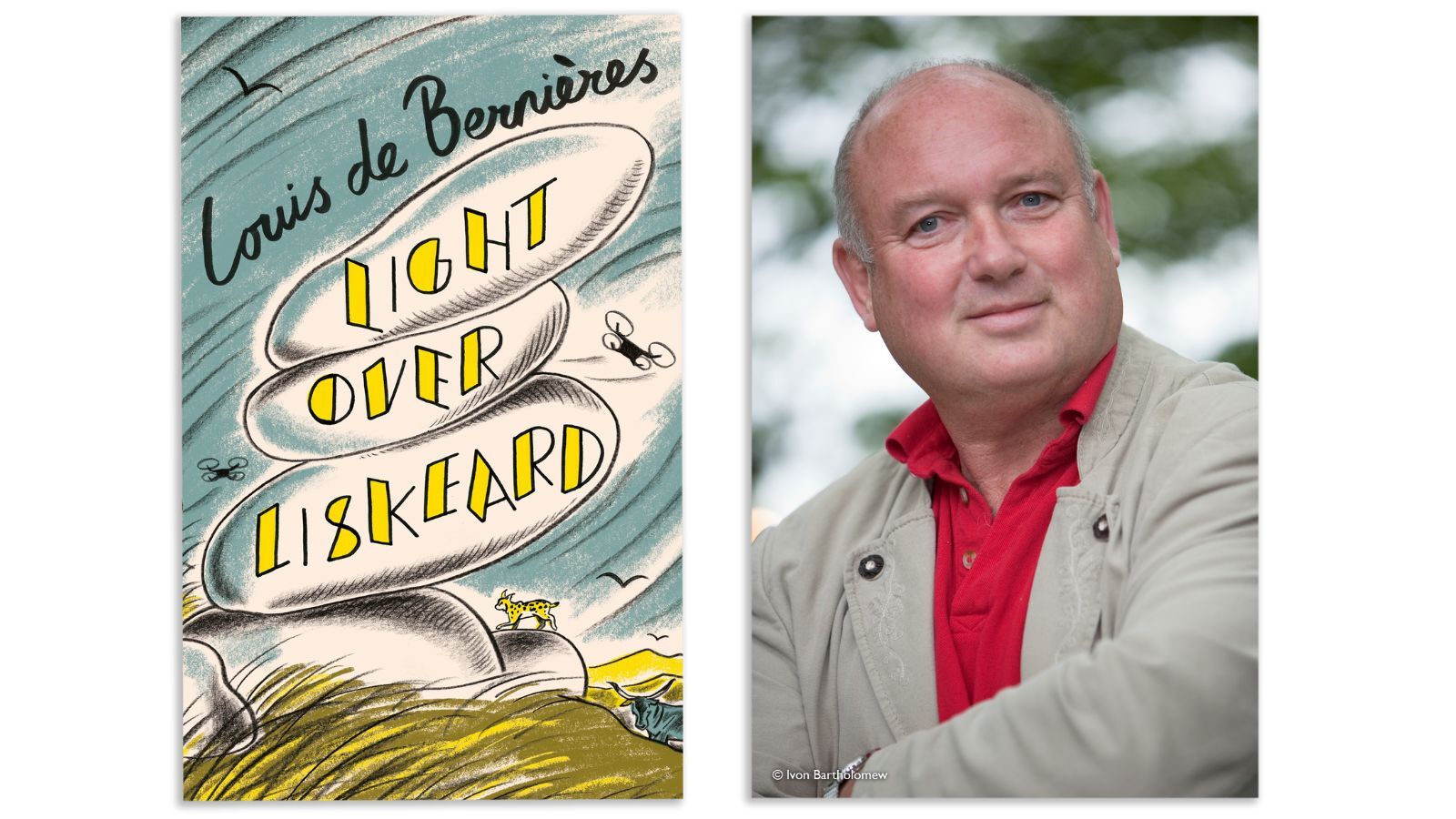
Louis de Bernières' Light Over Liskeard is shortlisted for the 2024 Wilbur Smith Adventure Writing Prize.
Sometimes we must look to the past to survive the future.
Q wants a simpler and safer life. His work as a quantum cryptographer for the government has led him to believe a crisis is imminent for civilisation and he's looking for somewhere to ride out what's ahead.
He buys a ruined farmhouse in Cornwall and begins to build his own self-sufficient haven. Over the course of this quest he meets the eccentric characters who already live on the moors nearby - including the park ranger in charge of the reintroduced lynxes and aurochs that roam the area; a holy man waiting for the second coming on top of a nearby hill; an Arthurian knight on horseback and the amorous ghost of an Edwardian woman who haunts the farmhouse.
As life in the cities gets more complicated, and our systems of electronic control begin to fall apart, Q flourishes in the wild Cornish countryside. His new way of life brings him back in tune with his teenage children, his ex-wife, and his own sense of who he is. He also grows close to Eva, energetic and enchanting, who is committed to her own quest for love and meaning.
In this entertaining and heart-warming novel, Louis de Bernières pokes fun at modern mores, and makes us reconsider what is really precious in our short and precarious lives.
About the Author: Louis de Bernières is the bestselling author of Captain Corelli's Mandolin, which won the Commonwealth Writers' Prize Best Book in 1995. His most recent books are The Dust That Falls From Dreams, So Much Life Left Over and The Autumn of the Ace, the short story collection Labels, the children's book Station Jim and the poetry collection The Cat in the Treble Clef.
WNSF: Congratulations on being selected for our shortlist! What does adventure writing mean to you? Would you have considered yourself an adventure writer before being shortlisted for the Prize?
Louis: I have not thought of myself as an adventure writer, but perhaps I should have. My characters all have adventures. I think of adventure writing as the sort of thing my parents read. They belonged to a book club that sent them a book every month, by authors such as Alastair MacLean and Hammond Innes. They also had a big collection of wartime memoirs and novels; I have read The Cruel Sea several times.
WNSF: Are there any particular books or authors which have made a lasting impact on you?
Louis: Thomas Hardy, the Writers of the Latin American boom, John Steinbeck, Flaubert and Shakespeare (of course). I have been influenced by dozens of writers really.
WNSF: Can you tell us about any adventurous experiences in your life? Have they influenced you as a writer or your writing?
Louis: My best adventure was finding my way to the top of the Andes, looking for my employer, who had gone off with an RAF expedition. I did the final part with some Incas who still had Spanish muskets, and pounded coca leaves and snail shells in small gourds. I found my boss at about 10,000 feet, near a crashed helicopter. Much of my first three books were set in the Andes!
WNSF: The Librarians and Library Staff who read, reviewed and selected your book for the shortlist asked a few questions too. One said, 'Light Over Liskeard deals with a world that has managed to turn in on itself, one that has been swallowed up by its own inventions. Do you think this is testament to our times?'
Louis: Absolutely. I set it in the future, but it’s all happening already.
WNSF: Another said, 'This novel deals with a topic that is vastly different to ones previously dealt with in your other works. How did you approach the subject? Did you have doubts? Cryptography and coding is a subject that most of us don’t know much about, did this require much research on your part?
Louis: It required some research, but in fact I have always been interested in this kind of thing. I did not have any doubts. I was inspired by an old photograph of my grandmother’s, by an article in The Week, by my own ‘back to nature’ romanticism, and exasperation with the way we are enslaving ourselves to electronic technology.
WNSF: One our our readers sent this question: 'One of the themes throughout the novel focuses on nature and how unforgiving it can be. Do you think nature in its purest form is in fact unforgiving, or has human interference, in particular the Anthropocene made it behave a certain way?
Louis: Nature is our mortal enemy and civilisation is our way of defending ourselves against it. The genius of all living creatures lies in our ability to use nature against itself and make it work for us. When we are clumsy about it, nature quickly gets her revenge.
WNSF: Can you tell us about a particular relationship between two characters in your novel and how you made it feel genuine?
Louis: I always write about the different kinds of love. For example, there’s a relationship between a man and his wife that is evolving away from romance into friendship. It’s such a common experience that almost all of us can recognise it.
WNSF: A strong sense of place is vital to any great adventure story. What role does research play in your writing? How did you make your setting feel realistic?
Louis: I spent happy hours wandering about Bodmin Moor and reading about it. I imposed my imagination upon what I experienced there. A place gives you distinct feelings, and I pass those on to readers without really knowing how I do it.
WNSF: We find that adventure often crosses into other genres, including crime and historical fiction. What kind of books do you like to read?
Louis: I read a lot of poetry, philosophy and science, and I like to read fiction from all over the world. It’s often accidental; I might meet a writer at a festival in Sri Lanka, and read all their books just for that reason. I am in a book club, and I love reading things that other people have imposed on me.
WNSF: What would you consider to be the upsides, and the downsides, of being an author?
Louis: The income is very irregular but it’s the nicest form of fame because nobody recognises you. I get to live in Fairyland and Lalaland for a great deal of the time. A downside is that you can become removed from daily life, and so run out of things to write about.
WNSF: What would you say is the hardest thing about writing? And the easiest?
Louis: The hardest thing is when you start a project and then have to abandon it because it isn’t going right. The easiest thing is when it’s going well, you get fired up, and you’re only writing for fun.
WNSF: What has been your toughest criticism as a writer? And your greatest compliment?
Louis: My old agent had a way of saying ‘wonderful’ which meant that my work was perfectly dreadful, so I dreaded it. I have had some wonderful compliments, such as ‘My mother died laughing when I was reading your book to her in the hospice.'
WNSF: Thank you so much for answering our questions, and congratulations again on being shortlisted!