
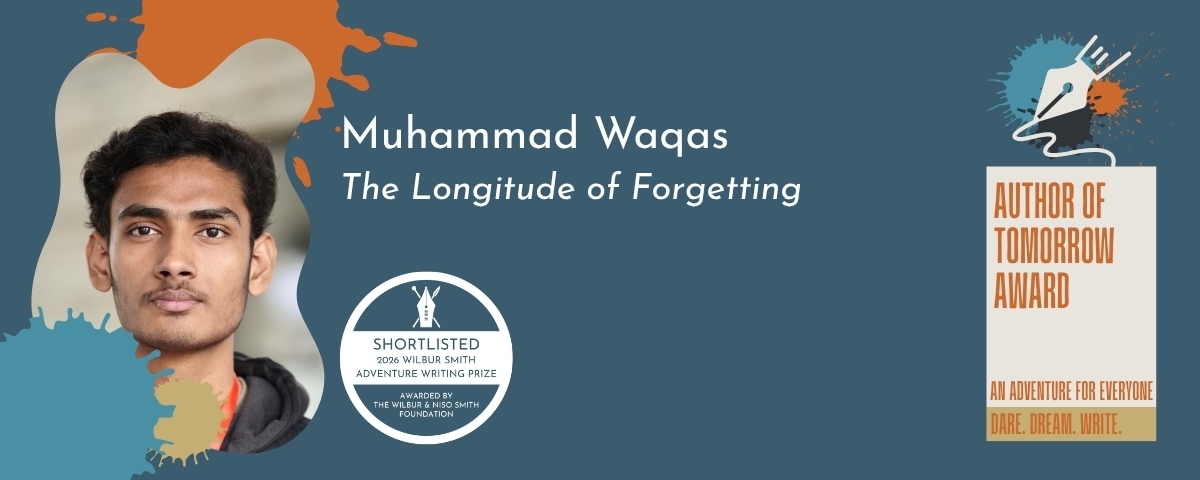
The Longitude of Forgetting by Muhammad Waqas is shortlisted for the 2026 Author of Tomorrow Award, 16-21 Category.
About The Longitude of Forgetting:
At over 4,000 meters in the Himalayas, nineteen-year-old Dara sets out alone to survey a glacier that did not exist months before. When the ice shifts beneath her, cutting off her path home, survival becomes only one part of the journey. Guided by a failing compass, her late father's surveyor's notebook, and the changing language of the mountains, she must navigate a landscape where nothing stays fixed. The Longitude of Forgetting is a story about discovery, resilience, and finding direction when every certainty begins to disappear.
An interview with Muhammad:
WNSF: What is your favourite book?
Muhammad: It would probably be Project Hail Mary by Andy Weir. I keep returning to it because of the way it turns problem-solving into something deeply human. Every challenge in the story is met with trial, error, and persistence, like thinking under pressure until clarity slowly emerges. What stays with me most is how curiosity becomes a survival tool. The character is constantly forced to work with incomplete understanding, yet still move forward step by step. That idea feels very close to how real exploration works, whether in space, in science, or in environments like mountains and glaciers where nothing is fully predictable.
WNSF: Who is your favourite author? Or one who has inspired you and why?
Muhammad: Robert Macfarlane has been one of the most important influences for me, especially in the way he writes about landscapes. What I admire most is how he treats places not just as settings, but as living systems shaped by memory, language, and time. His writing made me think more carefully about how we describe the natural world. Not just what we see, but how we choose to name and understand it. That idea stayed with me while writing my own story, especially in the way landscapes can feel both scientific and deeply emotional at the same time. I also appreciate how his work sits between disciplines. It is part travel writing, part science, part reflection. That combination feels close to how I think about storytelling as well, where observation and meaning are always connected.
WNSF: What is your favourite subject at school?
Muhammad: Physics. It’s the one subject where I don’t feel like I’m memorising the world but slowly catching up with it. What draws me in is not the formulas themselves but the way they force you to think under uncertainty, where you rarely have a complete picture and still have to move forward. That feels familiar to me, especially in situations where conditions change faster than your understanding can keep up. I like that physics doesn’t reward confidence, it rewards patience with confusion until something finally clicks into place.
WNSF: What does ‘adventure writing’ mean to you? Why did you choose to try your hand at an adventure story?
Muhammad: Adventure writing, to me, is less about explosions or distant places and more about the feeling of moving through the unknown while something inside the character is also shifting. I chose to write it because it lets me explore journeys where the external challenge and internal change run side by side, and where survival is not just physical but also about understanding what you are becoming while you move forward.
WNSF: If you could ask an author anything, what would you want to know?
Muhammad: I would want to ask how they know when a story is ready to be written instead of just thought about. For me, ideas often arrive early and unfinished, and I’m interested in how writers decide when to trust that an idea is strong enough to carry a full story, even if it is still unclear at the edges.
WNSF: Who would you consider one of your heroes and why?
Muhammad: One of my heroes is someone I don’t know personally but whose way of thinking has shaped how I see problem solving, Alan Turing. What I find inspiring is not just what he achieved, but the way he worked through uncertainty with logic when the outcome was anything but guaranteed.There’s something powerful about the idea that persistence in structured thinking can change the course of history, even in conditions that feel impossible.
WNSF: What is the most adventurous thing you would like to do, or place you would like to visit and why?
Muhammad: I think the most adventurous thing I would want is to spend time in places where the environment is still actively changing, like remote glaciers or high mountain systems where you can see the landscape reshape itself in realtime. It is less about thrill for me and more about understanding scale, how small human decisions sit inside very large natural processes, and how quickly certainty disappears when you are inside those systems.
WNSF: Where do you find inspiration for your stories?
Muhammad: I usually find inspiration in a mix of scientific ideas and lived environments. Books that blend storytelling with big questions about the world stay with me for a long time, but I am also influenced by real places, especially landscapes where change is visible and measurable, like mountains, glaciers, and remote terrain. Sometimes even a single scientific concept is enough to spark a story, if it raises a question that feels bigger than the idea itself.
WNSF: If you could time travel, where would you go and why?
Muhammad: If I could time travel, I think I would go to moments in scientific history where people were still building the foundations of how we understand the physical world, before the answers were settled. Not because I want a different world, but because I am curious about what it feels like to stand at the edge of understanding, when everything is still uncertain and even small insights can shift the direction of entire fields. I think I would want to observe how ideas first take shape when nothing is yet confirmed.
WNSF: What three words would you use to describe your story?
Muhammad: Fragile, persistent, inevitable.
WNSF: Congratulations on your brilliant story, and good luck for the next stage of the competition!