
Niall Edworthy's Otto Eckhart's Ordeal is shortlisted for the 2021 Best Published Novel award.
It is 1937 and an aimless young historian, back home after six years idling, is summoned to Berlin. He is both thrilled and uneasy to be tasked with an extraordinary assignment: find the Holy Grail and bring it back for the glory of Nazi Germany. Otto Eckhart is right to be anxious. Events soon take a troubling turn and, with a dire threat hanging over him, he is set on an impossible course from which there is no obvious escape.
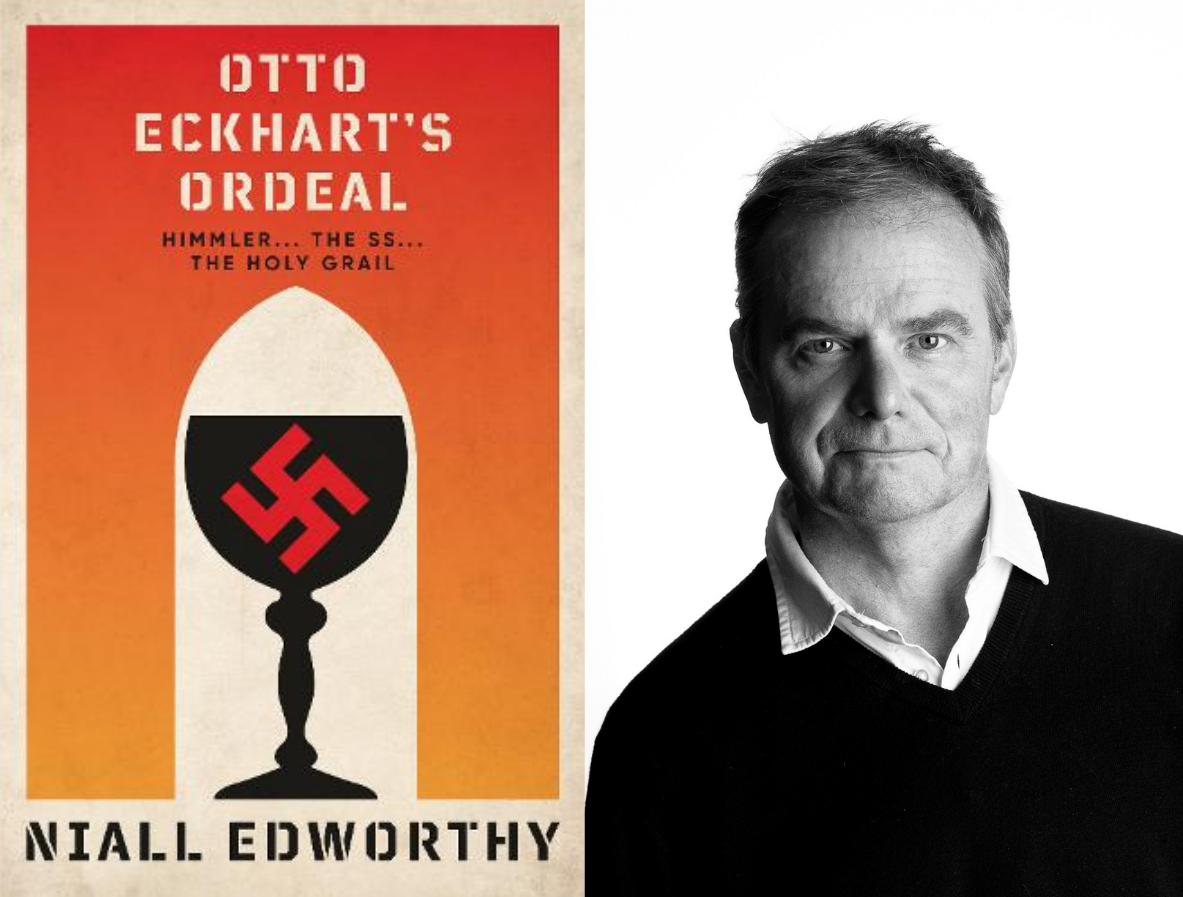
The feckless dreamer must use all his ingenuity and courage to defeat his inner demons and outfox Himmler’s SS and Gestapo. In hunting down the sacred chalice of The Last Supper, can Eckhart discover his own Holy Grail and come of age as a man? Otto Eckhart’s Ordeal is a darkly humorous tale inspired by true – and incredible – events.
About the Author:
Niall Edworthy, a former reporter with wire agencies AFP and Reuters, has been writing and ghosting books for 25 years. Otto Eckhart’s Ordeal is his first work of fiction. His work has covered a range of subjects including military history, biography, natural history, sport and humour. He is currently working on his second adventure novel, set in Syria and Iraq, and he is researching a sequel to Otto Eckhart’s Ordeal.
Niall has lived in the Sussex Downs for twenty years. When he is not writing or reading, he can often be found up in the hills and woods, walking or cycling.
WNSF: What does adventure writing mean to you? Would you have considered yourself an adventure writer before being shortlisted for the Prize?
Niall: Every good book should be an adventure, I believe - the energy, the momentum and the constantly shifting action propelling the reader onwards, forcing them to keep turning the pages. All my favourite books do this for me, never letting my mind wander, always demanding I find out what happens next. For me the reader, an urgent curiosity needs to be sustained to the very last. No genre can do this like true adventure writing.
I didn’t know what manner of (fiction) writer I would be until I gave it a go, but for the reasons given above, I suspect I knew that’s how I’d try and go about my story, working on the assumption that if it was exciting to write, it had a better chance of being exciting to read.
WNSF: Are there any particular books or authors which have made a lasting impact on you?
Niall: Every book that made me a big impression on me as a young boy was an adventure story: Moonfleet, Kidnapped, Eagle of the Ninth, Huckleberry Finn, The Hobbit. When I was a young man, it was the Flashman stories, CS Forester, Wilbur Smith, Alastair MacLean and Ian Fleming. Today, when asked about my favourite books, most seem to involve an exotic location, an adventure and, most times, an interesting historical setting: The Siege of Krishnapur, Burmese Days, The Painted Veil, the Patrick O’Brien Aubrey & Maturin novels, William Boyd, Robert Harris, Elmore Leonard, Stefan Zweig, Stephen King.
WNSF: Can you tell us about any adventurous experiences in your life? Have they influenced you as a writer or your writing?
Niall: My father was in the RAF so we moved around a great deal. Living in the States for three years until I was nine made a big impression on me. Forty years on, I can’t smell a hotdog, taste chlorine or feel the heat stepping off a plane without being transported straight back there. When we returned to the UK in 1975, it was to an entirely different world, shocking almost, and I like to think I have had a keen awareness of ‘place’ ever since. I love reading books that are evocative of place and, without making a concerted effort, I have found myself going to lengths to conjure it in my own writing. In researching Otto Eckhart’s Ordeal, I spent time in all the main locations and I’m not sure I would have been able to describe them all that well, had I left the effort entirely to my imagination.
I drifted a little after leaving Edinburgh University in 1989, working in bars and restaurants in London, went to Bar School with only half a heart, then got a break as a cricket reporter for the Independent on Sunday. Before I had time to reflect on where I was going, I was a journalist, and for the next eight years I worked for the wire services AFP and Reuters. That involved some travel, but even sitting in a Fleet Street office next to a machine chuntering out dispatches from around the world, my mind was always in far-flung places. Tasked as the ‘hooligan’ correspondent for three major football events, including the 1998 World Cup, was an adventure I could have lived without.
In the late 1990s, I was asked to pen a book for a well-known British actor and the next I knew I was a full-time ghostwriter, then an author with an agent, writing anything that put bread on table. (I have enjoyed most books I have written, but not all of them!) As a ghost, many of my adventures have been vicarious, lived through the person or people I’m writing for, but I have often had to travel and explore for the research. A highlight for me was writing Ray Mears’ Real Heroes of Telemark and spending a week in the frozen interior of Norway with the surviving Commandos who carried out the raid on Hitler’s atomic bomb plant there. Another thrill was living on base with a British tank regiment in Germany, putting together the story of their combat experience in the second Gulf War.
I have written about two books a year since my first, but all that time I knew that my greatest career adventure awaited: writing fiction. I lacked the confidence for putting myself out and as a ghost, of course, I was invisible. I could hide behind others. I think it takes courage to write fiction and I feel a better person for giving it a crack. It’s all I want to write now.
WNSF: Why did you choose to write about this time? Or this particular place in this time?
Niall: I have always been fascinated by the World Wars and have written/ghosted non-fiction stories about events and people in both conflicts. They are historical events that never stop giving to the storyteller. I had always looked at them from a British or Allied perspective, but recently I have ‘switched sides’, reading books and history that allow me to look at events the other way. It was not the main motivation behind writing Otto Eckhart’s Ordeal, but it was rewarding to try and imagine how it must have felt to become caught up in the nightmare of Nazism.
WNSF: As Otto Eckhart's Ordeal is a work of historical fiction, how do you make sure your characters, their voice and actions, sit comfortably within the historical context?
Niall: Good question – and one I kept asking myself throughout. I went to great pains to give my story ‘period’ authenticity by ensuring the language didn’t pull the reader out of the past and into the present. I also tried to add as many small details of everyday life back then: the food they ate, the cigarettes smoked, the newspapers read.
WNSF: A strong sense of place is vital to any great adventure story. What role does research play in your writing? How did you make your setting feel realistic?
Niall: As touched upon above, I felt that the sense of ‘place’ was crucial to the success of Otto Eckhart’s Ordeal. With the action moving between three main locations (Berlin, Midi-Pyrenees, Odenwald), I thought it important the reader got their money’s worth on that count, that they felt they were right there with Otto, fully immersed in his experience. I spent some time in all of them, my wife delighted to act as my ‘research assistant’ on each trip. With the other two key locations in the story – Wewelsburg Castle and Dachau - the sense of place was equally important, but in a different way. These are places readers will know about and be alert to how I have brought them to life. I didn’t visit them, partly owing to budget constraints, but also because most of the action at them takes place inside.
WNSF: We find that adventure often crosses into other genres, including crime and historical fiction. What kind of books do you like to read?
Niall: I read a great deal, roughly two books a week. For me, books are fuel; the more I read the better I am going to write, the more I am going to know, the more ideas for stories of my own are going to come to me. I have enjoyed a great diversity of books, but the ones I enjoy most are those in which it is all about the story and the writing invisible. The books I enjoy the least are those where you are being invited to admire the writing and the story has taken a back seat. For me, in reading and writing, it’s story, story, story all the way and I seek it out in every genre.
WNSF: What would you consider the upsides, and the downsides, are of being an author?
Niall: Upsides: the thrill of creation and connection, knowing what you write will, you hope, trigger an emotional reaction in a stranger a thousand miles away, lying in the shade of a tree, living in a cabin halfway up a mountain, sitting on a train or flying over an ocean. Through your imaginative efforts, you are sharing an experience with someone you will never meet.
Downsides: forever worried I’ve missed an obvious trick to make the story better; anxiety that all the hard work may come to nothing, that you won’t get a book deal, or if you do, it fails to reach an audience. And, of course, the time-honoured author’s anxiety about money and the next project.
WNSF: What would you say is the hardest thing about writing? And the easiest?
Niall: Hardest: the competition. There are so many great books out there, the mountain piling higher every year.
Easiest: Getting up from my desk and finding household tasks that demand my urgent attention.
WNSF: What has been your toughest criticism as a writer? And your greatest compliment?
Niall: Toughest: In reviewing a book I wrote as a young reporter, Britain’s best-known football writer said in The Sunday Times, ‘Edworthy reaches the nadir of naivety…’ Ouch. It still hurts today.
Greatest compliment: That what I had written read like watching a film.