
Nydia Hetherington's Sycorax is shortlisted for the 2025 Adventure Writing Prize.
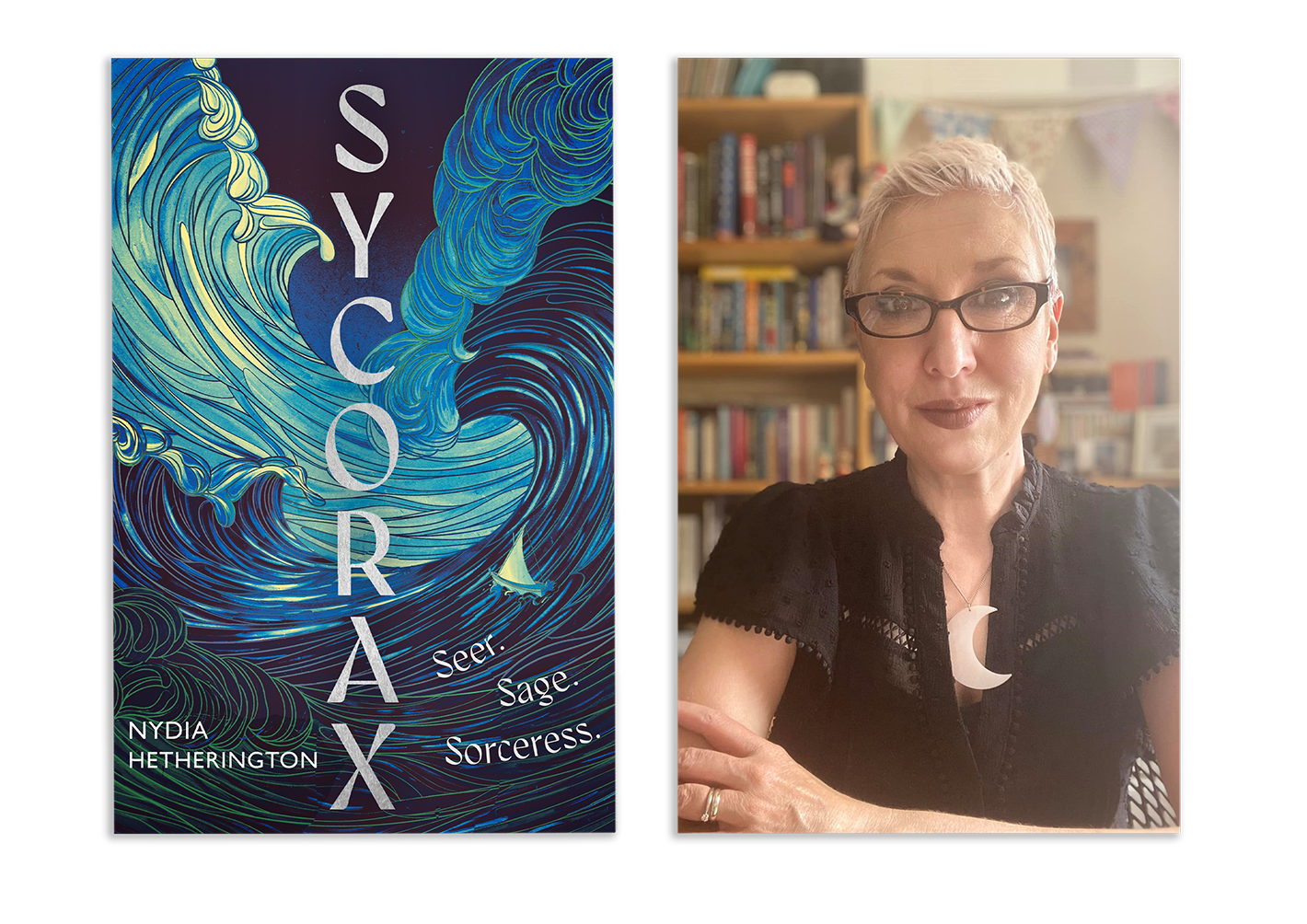
Born of the sun and moon, shaped by fire and malady, comes a young woman whose story has never been told...
They call her Sycorax. Seer. Sage. Sorceress.
Outcast by society and all alone in the world, Sycorax must find a way to understand her true nature. But as her powers begin to grow, so too do the suspicions of the local townspeople. For knowledge can be dangerous, and a woman's knowledge is the most dangerous of all...
With a great storm brewing on the horizon, Sycorax finds herself in increasing peril - but will her powers save her, or will they spell the end for them all?
A beautifully written and deeply moving imagining of what came before Shakespeare's The Tempest from the author of A Girl Made of Air.
An Interview with the Author:
WNSF: Congratulations on being selected for the 2025 Wilbur Smith Adventure Writing Prize shortlist! What does adventure writing mean to you? Would you have considered yourself an adventure writer before being shortlisted for the Prize?
Nydia: For me, adventure writing is, for whatever reason, writing that thrills, grabs and immerses me in the places and lives of a book. My reading life has been full of heart pumping moments when the page could not be turned quickly enough. And then the whirling feeling of that last page, that last sentence. My favourite books have all taken me far from myself, given me thrilling moments of fear, deeply felt emotion, anger and satisfaction. Writing has been my biggest adventure, though. My passion for stories and storytelling led me to write, even when I didn’t think I could. Sometimes feeling the fear and doing it anyway is the only thing you can do. I didn’t initially think of Sycorax as an adventure story, if I’m honest. But when the book was longlisted, it made sense. My Sycorax has the spirit of adventure embedded in her soul. She took me to incredible places of imagination and moments of personal endeavour to find her story. I never thought for a second that she’d bring me to be shortlisted for this amazing prize. But what a thrill it is.
WNSF: Are there any particular books or authors which have made a lasting impact on you?
Nydia: Yes, I definitely have books which are very dear to me and authors who inform and influence much of my own writing.
The Pirate by Sir Walter Scott is a book that stays with me, always. Norna of the Fitful Head is such an enigmatic and cleverly drawn character. She is gothic, misunderstood, powerful, and the ultimate outsider. I loved her instantly and can often be heard shouting ‘I am Norna of the Fitful Head’ whenever the mood takes me. It’s also a great rollicking story.
The House of the Spirits by Isabel Allende is another deeply important book for me. Not just for the political allegory, the family saga and the thrilling drama, but for the magic which is entwined so beautifully throughout the novel. I have read it in English and French but sadly never in Spanish as it’s not a language I know. This is a great sadness to me because I imagine Allende’s writing is even more wonderful in her own words. I really must learn Spanish!
Wuthering Heights by Emily Brontë is possibly my favourite ever novel. It was the first ‘serious’ book I read as a teenager, and I’ve gone back to it many times in my life. All the characters are awful and appalling but I still love them, passionately. I grew up in Leeds in West Yorkshire so somehow felt an affinity with the Brontës. Emily writes her story from a small, quiet place, but it is a huge and thrilling adventure of a book.
I also love the work of Angela Carter, whose fierce writing is a constant in my life. Unsurprisingly I am a huge, lifelong fan of Shakespeare. And there is a special place in my heart for the visionary poet William Blake.
WNSF: Can you tell us about any adventurous experiences in your life? Have they influenced you as a writer or your writing?
Nydia: The adventures I’ve had aren’t filled with marauding lions, and don’t have anything of the wild west about them. They are much quieter than that. Yet still, not for the faint hearted. I come from a working-class family and never expected to be able to do the things I’d so ardently dreamed about. Reading Billy Liar when I was young made me determined not to be like the main character, who dreams but never acts, even when opportunity arises. So, at twenty-one I hitched from Leeds to London, found somewhere to stay, got a job and eventually became an actor. Then at thirty, without speaking a word of French and with about £50 in my pocket, I moved to Paris. I’d somehow managed to secure a place at the renowned Jacques Lecoq theatre school, so without much thought, I went. When the course finished, I stayed in Paris and set up a theatre company, devising my own plays and finding my creative voice. I also worked with other theatre companies and was in a French production of Macbeth for three years. To have come to the country unable to say ‘bonjour’ to finding myself touring around France, on stage, with my heart in my mouth wondering what on earth I thought as I was doing as I launched into Shakespeare in french, was an adventure I’ll never forget. When I came back to London after almost a decade in Paris, I started writing. The richness of having lived, fully assimilated in another language and culture has been a bedrock for me as a writer. It impacts how I see the world and how I use words and even syntax, because I have different historical, cultural and societal points of view to inform my work. Being a foreigner, living beyond your boundaries is a wonderful experience for a writer. Also, European theatre is very different to UK traditions, and I learned all mine from the creative life I found there in my writing process. The whole adventure has been a huge influence on my writing.
WNSF: The Librarians and Library Staff who read, reviewed and selected your book for the shortlist also have a few questions for you! One asked: "Sycorax’s suffering is poignant and affecting. And we know that all that she endures leads inexorably into the events of The Tempest. It’s wonderful that you’ve given life to this character, but did you feel constrained by Shakespeare’s work in any way, either in plot as an end point to the novel?"
Nydia: I’m actually a Shakespeare nut! As a teenager I had posters of David Bowie on my wall along with old theatre programs of Shakespeare plays. I say this because along with my other reasons for wanting to tell Sycorax’s story, writing the novel was also my attempt at a homage to one of my heroes. The Tempest gave me a solid frame to work from when writing Sycorax and in a strange way, this was very freeing. Within that framework I could take the story anywhere. At the same time, I always knew where I was going, which has not always been the case with my writing. Sycorax had one destination, the island, I just had to get her there. In the play, we are told very little about Sycorax herself, so for me, she really was a blank page. I also think Shakespeare is extremely clever in the way he mirrors Prospero’s actions in The Tempest to those of the ‘blue-eyed hag’ he enslaves, he uses his power to threaten Arial with a torture worse than Sycorax’s. Then Shakespeare gives Caliban, Sycorax’s son, the most beautiful speech in the play. I’ve always believed Shakespeare to be showing us, silenced as she is, that the so called ‘foul witch’ has been very wronged. The thing that did sometimes threaten to overwhelm me, was that I might be being too audacious in writing what is essentially a prequel to The Tempest.
WNSF: Another asked, "I know you have spoken previously about having rheumatoid arthritis – I’d be interested to know how this has informed your writing generally, and the character of Sycorax?"
Nydia: Writing about chronic illness, giving focus to what it’s like to live with invisible disability, unwellness and pain, was a must for me. Rheumatoid Arthritis (RA) defines my life in that it impacts every bit of every day. So even when I’m not writing about it directly, it’s still there. I’d wanted to write Sycorax’s story for a long time, almost a lifetime really, but I could never find my way in. Either that or I didn’t have the confidence to do it. When COVID hit and I was shielding due to being clinically vulnerable, my world changed. It was an extremely isolating time. But it wasn’t just the physical isolation, there was the huge emotional impact as I suddenly felt the weight of being ‘othered’. It was a very lonely experience. Unfortunately, my RA had also taken a turn for the worse but because of the health crisis it was impossible to see a consultant or get more adequate medication. So, I was left in a great deal of pain without any way to manage it. Somehow, the desperation and enforced solitude took me back to Sycorax, abandoned and alone on her island. I couldn’t help but think about her, to put the pieces together. And like that, I’d found my way in.
WNSF: They then asked: "I also learned that you were in a production of The Tempest back in the 90s! What was it about the character of Sycorax that stayed with you over the years, especially after your experience in a Tempest production? How did that interest grow into a novel?"
Nydia: Ah yes, it was a very bad fringe production, but it was also an absolute dream in that I got to know the play really well. I think as rehearsals went on, hearing Prospero condemn his female counterpart rattled me somewhat. Why was he a great magician and she a hag and a witch? They both used magic for good and ill. The young, raging feminist in me got her hackles up and I wanted to know more about this woman who had birthed Caliban, supposedly a monster, alone on a deserted island. She was much more attractive to me than Prospero and his books and she pulled me in. So much so, I spent years, decades even, thinking about her. By the time I wrote the book she’d been with me for so long that as soon as the conditions were right, she spilled out onto the page.
WNSF: They followed that question up with this one: "Having a theatrical background when you were writing Sycorax's story, were you visualising it unfolding purely in novel format or with any theatrical interpretation? Would you like to see her story play out on the stage in the future?"
Nydia: I do always see what I’m writing, as if the scene is being played out before me. So yes, I definitely saw her story unfold in that way. It’s interesting to think that this might be due to the years I spent as a theatre maker, and I do sometimes wonder. I must admit though, I’m also a bit obsessed with how words look on the page as I put them down, so there’s a real mix of realities going on as I write. I’m not sure if I’d like to see Sycorax’s story on stage. After years of looking for her, it was the novel form that brought her to me, so I feel she sort of belongs in the book. I’d probably be excited by seeing someone else’s stage interpretation of my novel though, rather than doing it myself. My interest is firmly on the page rather than the stage these days.
WNSF: Thank you so much. A strong sense of place is vital to any great adventure story. What role does research play in your writing? How did you make your setting feel realistic?
Nydia: Research was a huge part of writing Sycorax. Not only was I setting the book in a fictional version of Algiers, but it was also in the 16th century. Basically, I read everything I could get my hands on about the history of the barbary coast, from academic papers to poetry and fiction. I spent hours looking at paintings and etchings, comparing them. I looked at costume and clothing, plants, birds and migration patterns, animals and habitat, even jewellery making. Maps also played a big part in my research, ancient and modern, so that I could trace exactly where I was and really try to visualise it. Honestly, I was terrified of getting my facts wrong, so I tried to learn about everything. But that fear eventually started to slow me down so in the end, I had to move away from the research and trust my imagination more. I told myself that I am an English writer in the 21st century and that is the truth of my perspective. Shakespeare certainly got things wrong, and so I gave myself a bit of creative space. When I did that, writing the landscape, the place and setting, became a much more organic process. I still wanted to be accurate, but at last I could feel my feet on the sandy earth, so that my imagination was able to breathe life into the writing. It was important to get that balance right, to let the story live freely, grounded in its setting.
WNSF: We find that adventure often crosses into other genres, including crime and historical fiction. What kind of books do you like to read?
Nydia: I’m very fond of books that are steeped in folklore. They were the stories we told to make sense of a baffling world and I find they can still do that today, beautifully. I tend to read novels that are set in the past, not always the far past, but certainly not stories that unfold in the now. Saying that, I have a fondness for future dystopian and speculative fiction. Looking at my bookshelves, there’s definitely a nod to the magical and uncanny. Also, I like to be taken on a good journey. In the end, I’m a sucker for a rollicking story, so if something fits that bill, it doesn’t matter what the genre, I’ll be reading it.
WNSF: What would you say is the hardest thing about writing? And the easiest?
The hardest thing about writing is having to write. And the easiest part of writing is having to write. It’s a strange, wonderful, and sometimes painful dichotomy.
WNSF: Thank you so much for answering our questions, Nydia. And congratulations once again.
If you read and loved Sycorax as much as we did, you can vote for it to win the Prize here. If you haven't yet read it, you can purchase your copy here:
About the Author:
Originally from Leeds, Nydia Hetherington moved to London in her twenties to embark on an acting career. Later she moved to Paris where she studied at the Jacques Lecoq theatre school before creating her own theatre company. When she returned to London, she completed a creative writing degree at Birkbeck.
What Our Reviewers Said:
"This is a captivating novel that reimagines the life of Shakespeare's infamous witch. With rich, vivid writing and a deep emotional core, this book dives into Sycorax's journey from outcast to powerful sorceress."
"It's a perfect blend of history, fantasy, and myth, making this story both unique and engaging. The novel successfully offers a fresh take on a classic character. I found it to be a great, rewarding read."