
Jock Serong's Preservation is shortlisted for the 2019 Best Published Novel award. Preservation is based on the true story of the wreck of the Sydney Cove: in 1797 on a beach not far from the young and isolated settlement of Sydney, a fishing boat picks up three shipwreck survivors, distressed and terribly injured.
They have walked hundreds of miles across a landscape whose features—and inhabitants—they have no way of comprehending. They have lost fourteen companions along the way. Their accounts of the ordeal don't quite correlate.
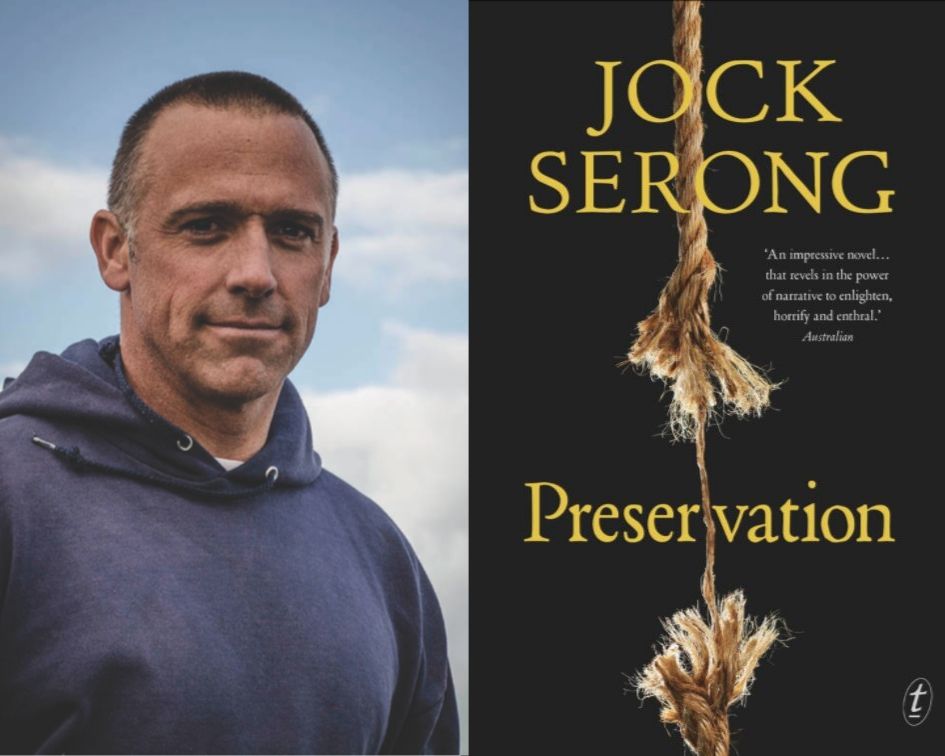
About the author:
Jock Serong is the author of Quota, winner of the 2015 Ned Kelly Award for Best First Fiction; The Rules of Backyard Cricket, shortlisted for the 2017 Victorian Premier’s Award for Fiction, finalist of the 2017 MWA Edgar Awards for Best Paperback Original, and finalist of the 2017 INDIES Adult Mystery Book of the Year; and On the Java Ridge, shortlisted for the 2018 Indie Awards.
WNSF: What does adventure writing mean to you? Would you have considered yourself an adventure writer before being shortlisted for the Prize?
I suppose adventure writing to me is storytelling that creates an urgency about the survival of the central characters. It somehow pits the landscape – as well as sundry villains – against their quest; a feeling that in my case comes from childhood reading where hardship and ingenuity were the thrills.
Was I an adventure writer beforehand? Yes as a journalist, but not as a novelist; with the possible exception of my previous novel, On the Java Ridge, which told the story of an asylum-seeker boat which is wrecked in a storm off northern Australia. The survivors are rescued by a bunch of travelling surfers in a charter boat, setting off a catastrophic chain of political maneouvers back in Australia. I think I was so caught up in the moral/political dimensions of the story that I never thought of it as an adventure. But looking back now, perhaps it is.
WNSF: Are there any particular books or authors which have made a lasting impact on you?
My notions of adventure are heavily influenced by the sea. There are so many books and writers that it’s difficult to single any out, but obviously Moby Dick (surely the perfect adventure novel). Early on, I was I huge fan of Willard Price’s Adventure series, and a fairly obscure kids’ book by crime writer Mickey Spillane called The Day the Sea Rolled Back. Enid Blyton, Jules Verne, Conrad…these writers still influence me in ways that are quite subterranean, I think.
A few years ago I was struck by Ian McGuire’s The North Water– it pays homage to the classic sea-borne adventure writing of the nineteenth century. And more recently in Australia, Jane Rawson wrote an instant classic called From the Wreck.
WNSF: Can you tell us about any adventurous experiences in your life? Have they influenced you as a writer or your writing?
Writing about the sea has at times necessitated living the experiences I’m trying to describe. A few years ago I published and edited a magazine called Great Ocean Quarterly, and operating on a shoestring had the unintended consequence that I had to go and do a lot of the adventure journalism myself, including at one stage scaling a thousand-foot cliff out in the Southern Ocean off Tasmania with expensive photographic gear strapped to my back.
I’ve come to grief delivering a half-built yacht off South Australia and nearly drowned when I trapped myself trying to pull a crayfish out of an underwater cave…in five feet of water on a bright sunny day. Most of these ‘adventures’ have been brought about by stupidity, not necessity, and despite that dastardly handful, I do not consider myself a daring person. Most of the time I drink coffee and type.
WNSF: A strong sense of place is vital to any great adventure story. What role does research play in your writing? How did you make your setting feel realistic?
Research was vital in the making of Preservation, and it took a variety of forms, from the ordinary documentary stuff in libraries and online, to swimming over the wreck of the Sydney Coveand flying between islands in a chopper. I drove the coastline that the Sydney Cove survivors walked, and I would love to say I walked the whole thing too, but that would be a shameless lie, even for a fiction writer. What I did instead was drive to the coast, get out and walk and feel the sand, smell the rain, look up at the trees, eat things, ruminate and scramble over boulders. It was a constant process of trying to imagine the same coastline 220 years ago, trying to see with the imagination as much as with the eyes.
Q: If your novel is historical fiction, why did you choose to write about this time? Or that particular place in this time?
I chose a long-forgotten incident in 1797 because I wanted to explore the early years of colonisation in my country and try to imagine it through Indigenous eyes. Sydney was only nine years old at this stage: there was no Hobart, no other township on the entire continent. Aboriginal people had occupied the land for something like 60-80,000 years by then, but the invaders (or settlers, or colonisers – the language is loaded in this discussion) considered themselves to be settling an unoccupied terra nullius. It was a fiction, of course, they could see the First Australians there in front of them, but their presence didn’t suit the colonial worldview.
Australians tend to assume that first contact was between British soldiers and Aborigines, but because the Sydney Covewas largely crewed by Indian lascars, those first encounters were most likely between Indian people and Aborigines, so the interactions are immediately different. It’s a ready opportunity to reconsider all sorts of things we’ve taken for granted about settlement. Indigenous writer Bruce Pascoe did this in much more scholarly fashion, and before me, in his book Dark Emu, which throws out all sorts of assumptions about “nomadic” Aborigines not living in settled communities. His research was like gold to me.
WNSF: Can you tell us about a particular relationship between two characters in your novel and how you made it feel genuine?
The mystery of the Sydney Cove’s sinking, and the remarkable (true) tale of its survivors, are investigated in my novel by a (fictional) lieutenant named Joshua Grayling. He’s a decent man, Joshua, but he’s a product of his upbringing and his class: a naval officer, rigid, something of a concrete thinker. So his wife, Charlotte, is a perfect foil to him: she’s empathetic, smart, and constantly chafing against the restrictions that colonial society places on her. She likes to walk in the forest, to get herself lost out in the giant trees in the grip of this kind of sensory tsunami, staggering home barefooted and filthy. It’s a habit that terrifies her strait-laced husband and creates friction between them: she is both his ally and lover, and also his greatest frustration. They discuss it at times, but the bulk of their thoughts about their different lives are unspoken, worried over in the dead of night. I think that could be a description of many marriages.
WNSF: We find that adventure often crosses into other genres, including crime and historical fiction. What kind of books do you like to read?
I read very widely, much more widely than I did before I was published. The reasons for this probably have to do with the work: there are books to blurb, books to review, books that my publisher sends me, books written by fellow panellists at festivals and ones that your mates have written, and which you need to be familiar with because you love ‘em.
So whereas I used to read a lot of classics, a lot of dead white males, now I’m trying to keep up with new fiction in Australia and New Zealand, as well as tonnes of non-fiction that feeds into the themes I’m writing about. I don’t know if you would call this ‘research’, but it’s more an accretion of subtle influences. And it means the reading is much more diverse, in genre, gender and ethnicity, than it used to be. Which is surely a good thing.
WNSF: What would you consider the upsides, and the downsides, are of being an author?
Easy.
Upside: constant fascination.
Downside: money.
WNSF: What would you say is the hardest thing about writing? And the easiest?
The easiest thing, strangely, is the writing. It’s such a joy, and hours fly past when the angels are singing and it’s all working like it’s supposed to. But I think the hardest thing is making the room in your life to dothe writing. Despite that fact that I consider my writing my career, it can still appear to outsiders as a cute hobby, something that needn’t necessarily occupy long periods of uninterrupted time, or even be properly paid for.
The side-hustles that generate cash, the perfectly legitimate needs of family, the desire to be out in the sun, all of these things compete for the hours that could be devoted to writing. And some of them have superior claims to that time: I do not want to be remembered as an absent - or absent-minded - husband and father. But some of them are straight-up bullshit, and must be resisted at every turn.
WNSF: What has been your toughest criticism as a writer? And your greatest compliment?
I had an argument with my teenage daughter, and in frustration she spluttered “Do you understand what I’m saying, or do I have to explain it in really big words for you?”
I think that’s a criticism. It’s so good that I’m still processing it.
The winner of this year's Wilbur Smith Adventure Writing Prize will be revealed at a special ceremony in London on 12th September 2019.